


Double Bundle ACL Reconstruction
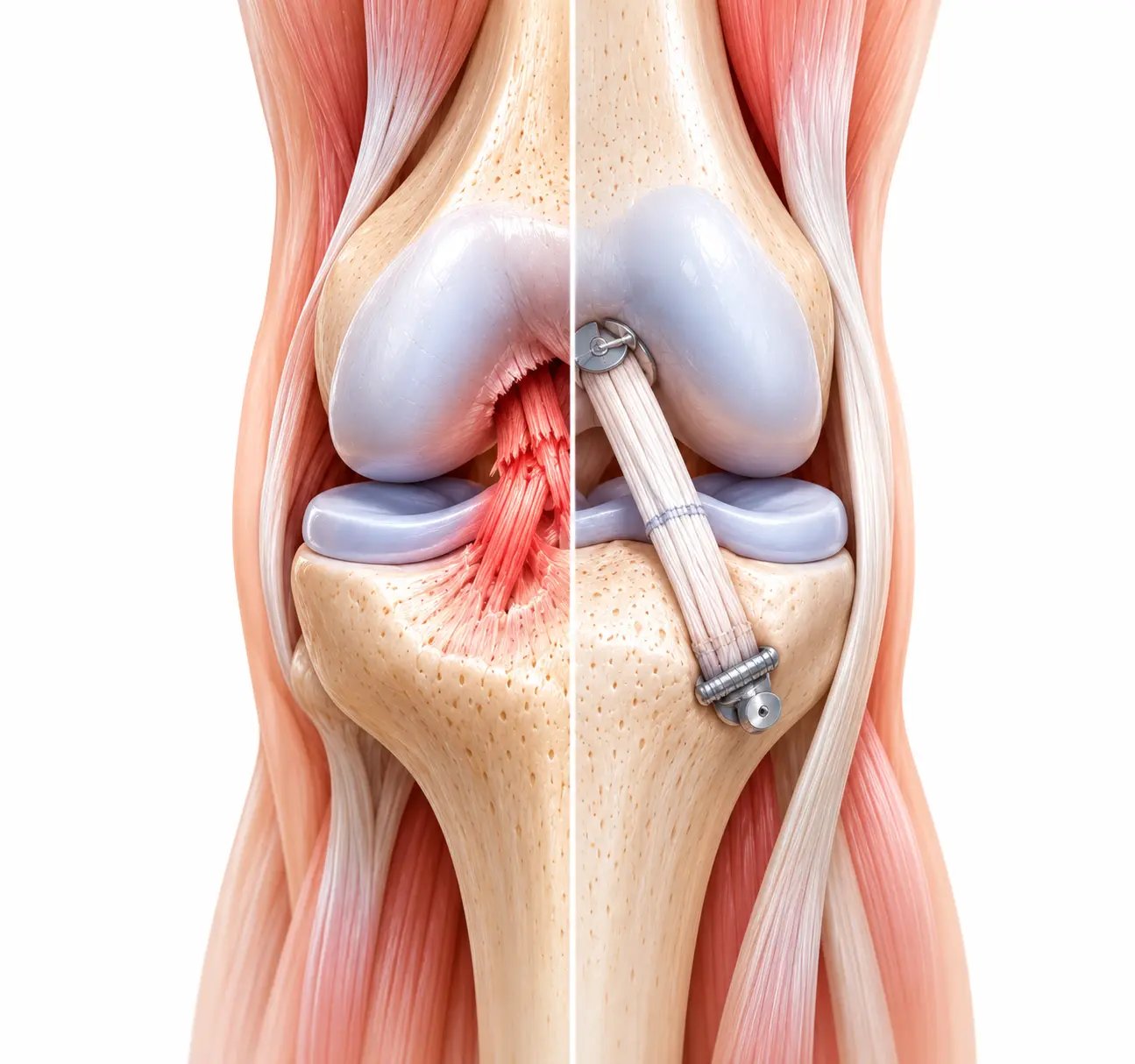
Your natural ACL is made of two bands that work at different angles. This technique rebuilds both of them separately instead of one, aiming to copy the original anatomy as closely as possible.
Animation or OT footage showing both bundles being placed and fixed at different knee angles.
What is double bundle ACL reconstruction?
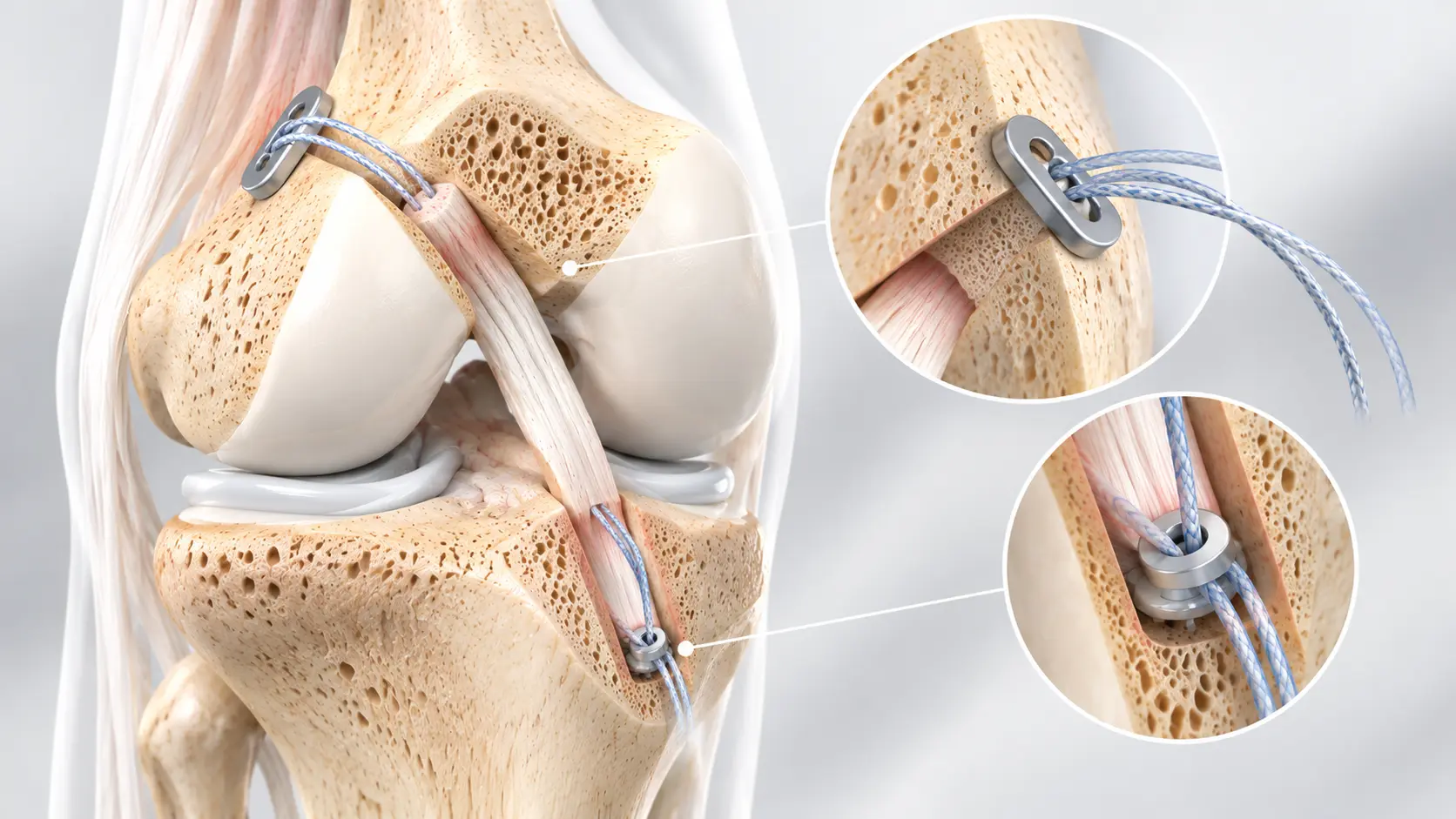
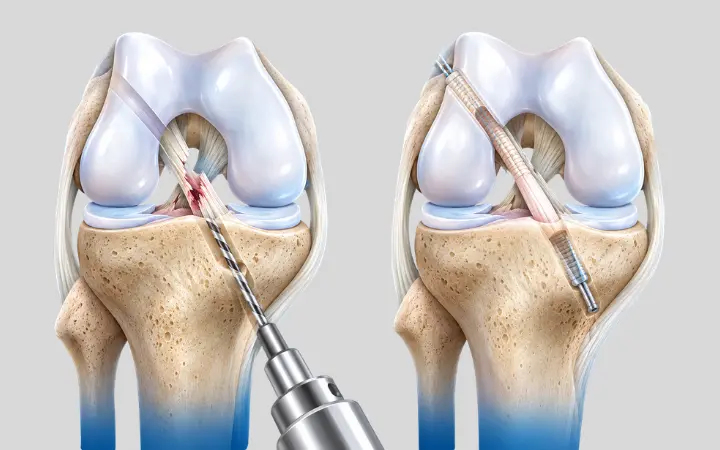
Your ACL is not a single cord. It has two bands that tighten at different points as the knee bends, and together they control both forward sliding and twisting. A double bundle reconstruction rebuilds both bands rather than one.
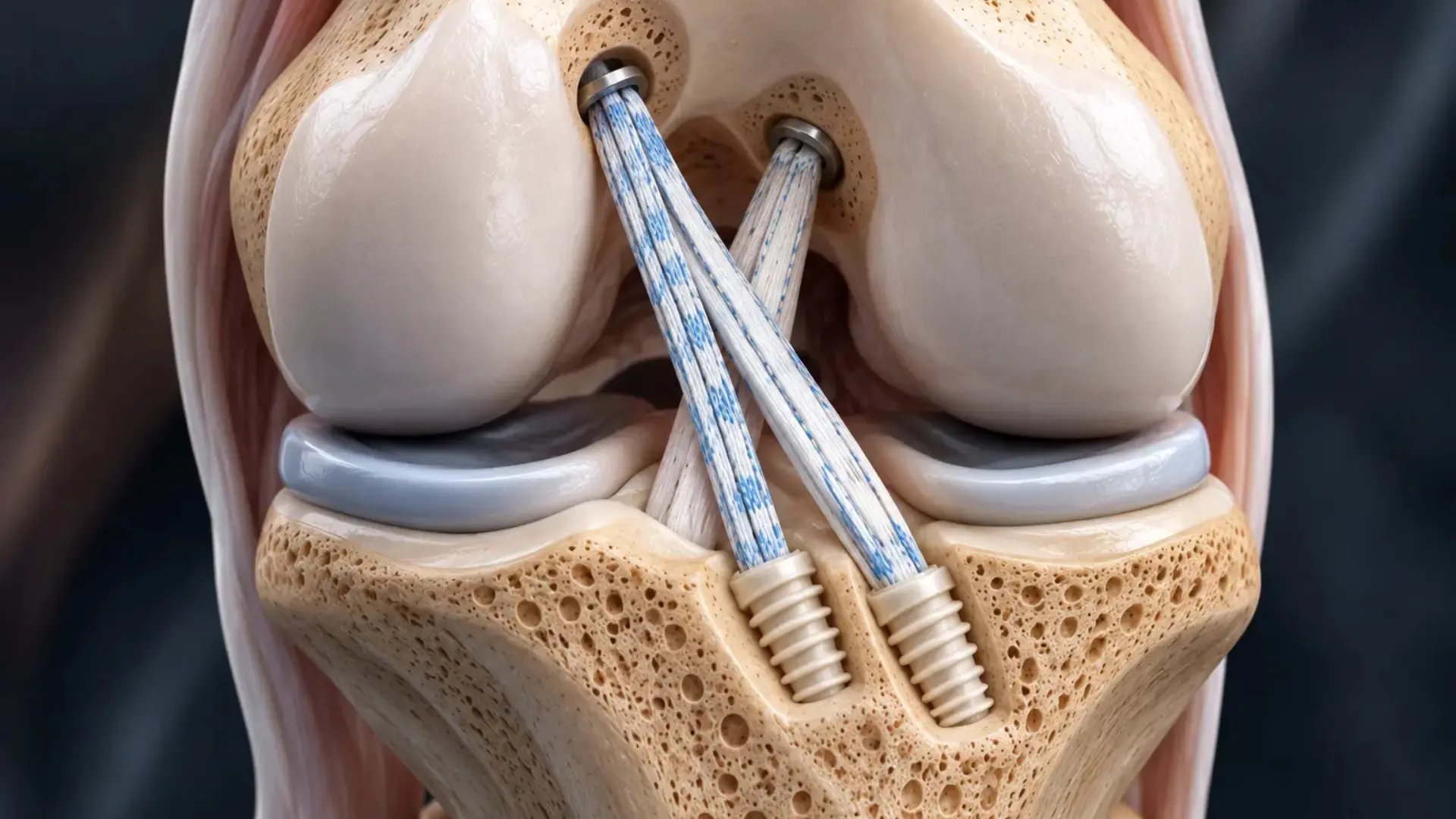
Because each band needs a tunnel at the top and a tunnel at the bottom, the operation uses four tunnels in place of the usual two, and the two bundles are tightened at different knee angles so that neither one chokes the other.
The honest summary of the evidence is this. The idea makes good anatomical sense and laboratory studies support it, but when the results of real patients are pooled, double bundle has not clearly beaten a well placed single bundle on stability tests or on function scores. It is a specialised choice for selected knees, not an automatic upgrade.
Who this technique suits
The knee itself has to have room for two bundles. This is measured during the arthroscopy, not guessed from the MRI alone.
Usually a good fit
- A large ACL attachment area, with space for two separate tunnels
- A wide enough notch, the groove the ligament runs through
- Athletes whose sport is built on cutting and pivoting
- Knees with marked rotational looseness on examination
- Enough graft tissue available to make two good bundles
Not suitable
- A small attachment area or a narrow notch
- Children and teenagers with open growth plates
- Revision surgery where old tunnels already occupy the bone
- Significant arthritis or a heavily damaged knee
- Thin grafts that cannot be split into two usable bundles
How the surgery is done
-
01
Anaesthesia and examination
Under spinal or general anaesthesia the knee is examined again, with particular attention to how much it rotates, since that is what this technique targets.
-
02
Footprint is measured
The camera goes in and the old ACL attachment is measured. If the area or the notch is too small for two tunnels, the surgeon proceeds with a single bundle instead.
-
03
Graft is harvested and divided
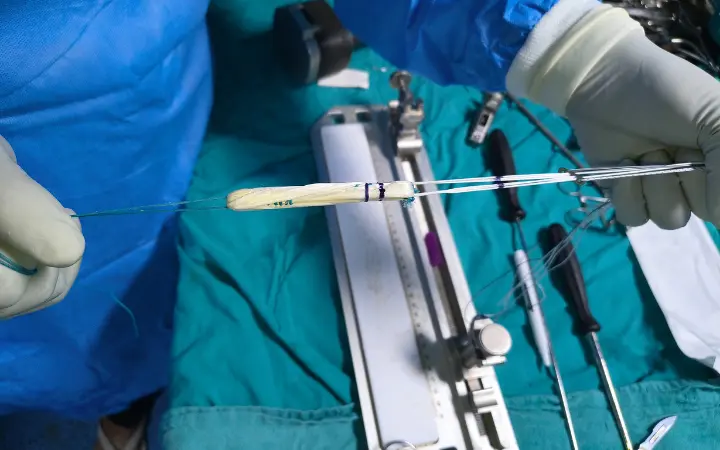
Tendon is taken and prepared as two separate bundles, usually one thicker and one slightly thinner, each with its own fixation attached.
-
04
Two tunnels in the thigh bone
Two sockets are drilled at the exact positions where your two original bands attached, with a bridge of bone left between them.
-
05
Two tunnels in the shin bone
The same is done at the lower attachment. Spacing matters here, because tunnels placed too close can break into each other.
-
06
Bundles fixed at different angles
One bundle is tightened with the knee nearly straight and the other with the knee bent. This sequence is what lets the two bands share work the way the original ligament did. The cuts are then closed.
Tightening both bundles at the same angle is the classic pitfall. It can leave the knee stiff or load one bundle far more than the other, which is why the fixation order and the knee angles are planned in advance.
Which graft is used
This technique needs more tendon than a single bundle, because two separate bundles of adequate thickness have to be built from it.
Both hamstring tendons
The usual choice, with one tendon used for each bundle.
Peroneus longus
Adds length and bulk when the hamstrings alone are not enough.
Quadriceps tendon
A broad graft that can be split into two bundles in selected cases.
Recovery at a glance
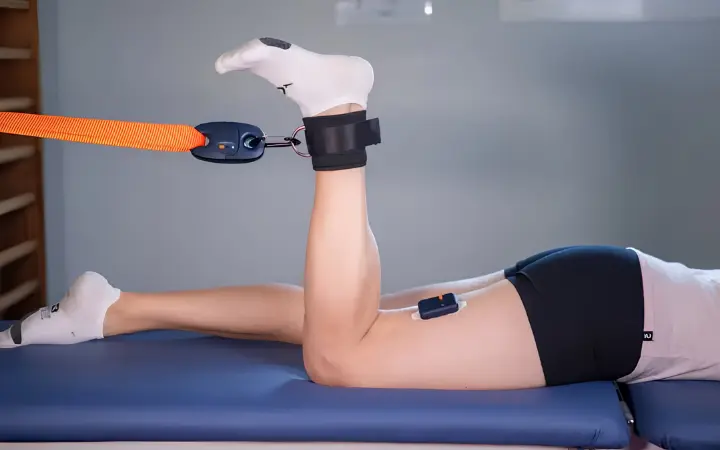
The rehabilitation plan is the same as for a single bundle. Two grafts do not heal into bone any faster, so the milestones do not move. Getting full straightening back early matters here, because stiffness is the complication this technique is watched for most closely.
Open the full recovery roadmapBenefits and trade-offs
Benefits
- Copies the natural two band anatomy more closely
- Laboratory testing shows better control of twisting loads
- Covers a large attachment area that one graft may leave partly empty
- An option worth discussing for high level pivoting athletes
- Each bundle can be tensioned for the job it does
Trade-offs to know
- Pooled patient results have not shown clear superiority over single bundle
- Longer and technically demanding, so surgeon experience matters
- Four tunnels make a future revision surgery harder to plan
- More tendon is taken and more implants are used
- Higher total cost than a standard reconstruction
A pooled analysis of around a thousand patients found no significant difference between double and single bundle on the pivot shift test, the Lachman test, or on function scores. That does not make the technique wrong, it means a precisely placed single bundle already does most of the job. Our view is that the quality of tunnel placement matters more than the number of bundles.
Cost of this surgery
Higher than a single bundle because two bundles need two sets of implants and more operating time.
Most health insurance policies cover ACL surgery after their waiting periods, and our team can help you with the paperwork.
Common questions
What are the two bundles?
They are the two bands your natural ACL is made of. One tightens more when the knee is bent and mainly stops the shin sliding forward, the other tightens more when the knee is straight and does more of the work against twisting.
Is double bundle better than single bundle?
Not as a rule. It is closer to natural anatomy and performs better in laboratory tests, but when patient results are pooled, stability and function scores come out similar. It is best thought of as an option for particular knees rather than a better version for everyone.
Will I have more or bigger cuts?
No. It is still keyhole surgery through small cuts. The difference is inside the knee, where four tunnels are drilled instead of two.
What if my knee turns out to be too small for it?
Then a single bundle is the safer operation and your surgeon will do that instead. Forcing two tunnels into a small attachment area risks the tunnels joining into each other, which weakens the fixation.
If it fails, is revision surgery harder?
Yes, usually. Four tunnels leave less untouched bone for a revision, which may mean bone grafting first and a second operation later. This is one of the main reasons the technique is used selectively.
Does recovery take longer?
No. The rehabilitation plan and the nine month sport milestone stay the same. Regaining full straightening in the early weeks is watched a little more closely.
This page explains a surgical technique in general terms. What suits your knee is decided after a clinical examination and MRI review with an experienced ACL reconstruction surgeon in Indore.


Dr. Prince Uchadiya

Thank You,
Patient!
Your appointment request has been received.
Our clinic team will call you shortly to confirm your consultation and share further details.
 Confirm on WhatsApp
