

Internal Brace Augmentation
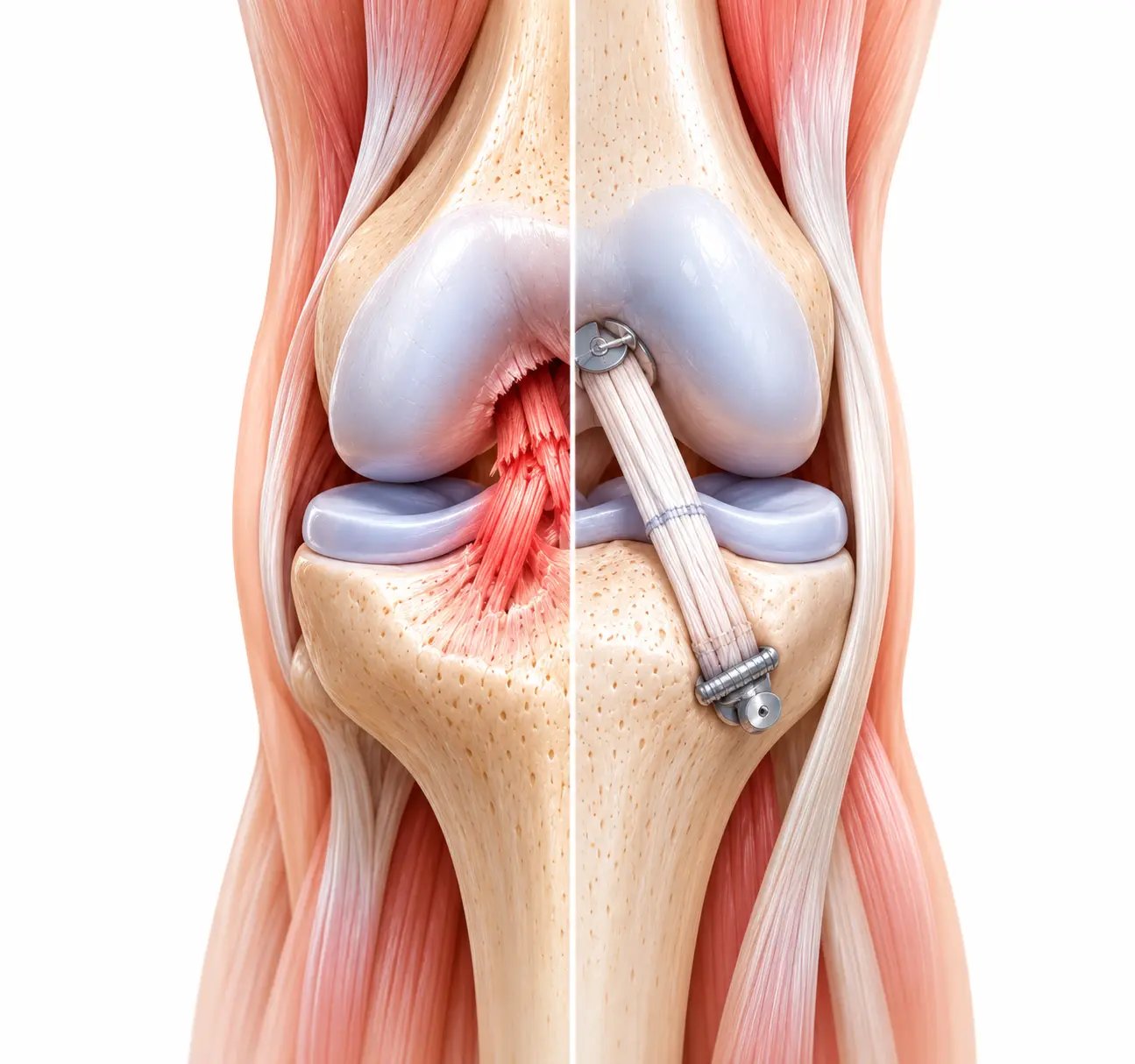
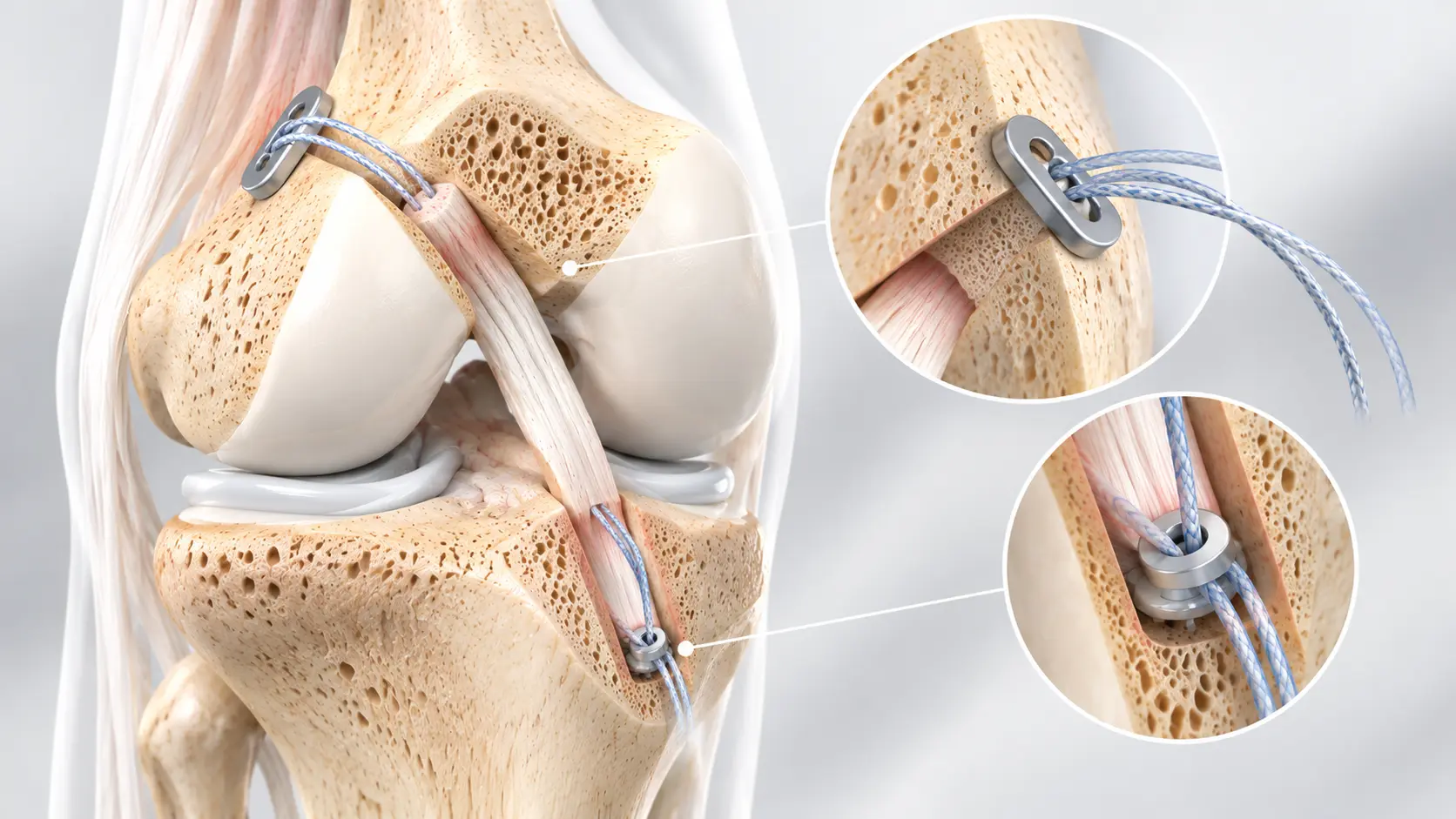
A strong suture tape is placed alongside the new ligament and anchored to bone at both ends. It works like a seat belt, sharing the load while your graft goes through its weakest healing phase.
Animation or OT footage showing how the suture tape is passed and anchored alongside the graft.
What is internal brace augmentation?
It is not a separate operation and it is not a replacement ligament. It is a strong, flat suture tape placed next to your graft during ACL surgery and fixed to the bone at both ends, so the two share the load.
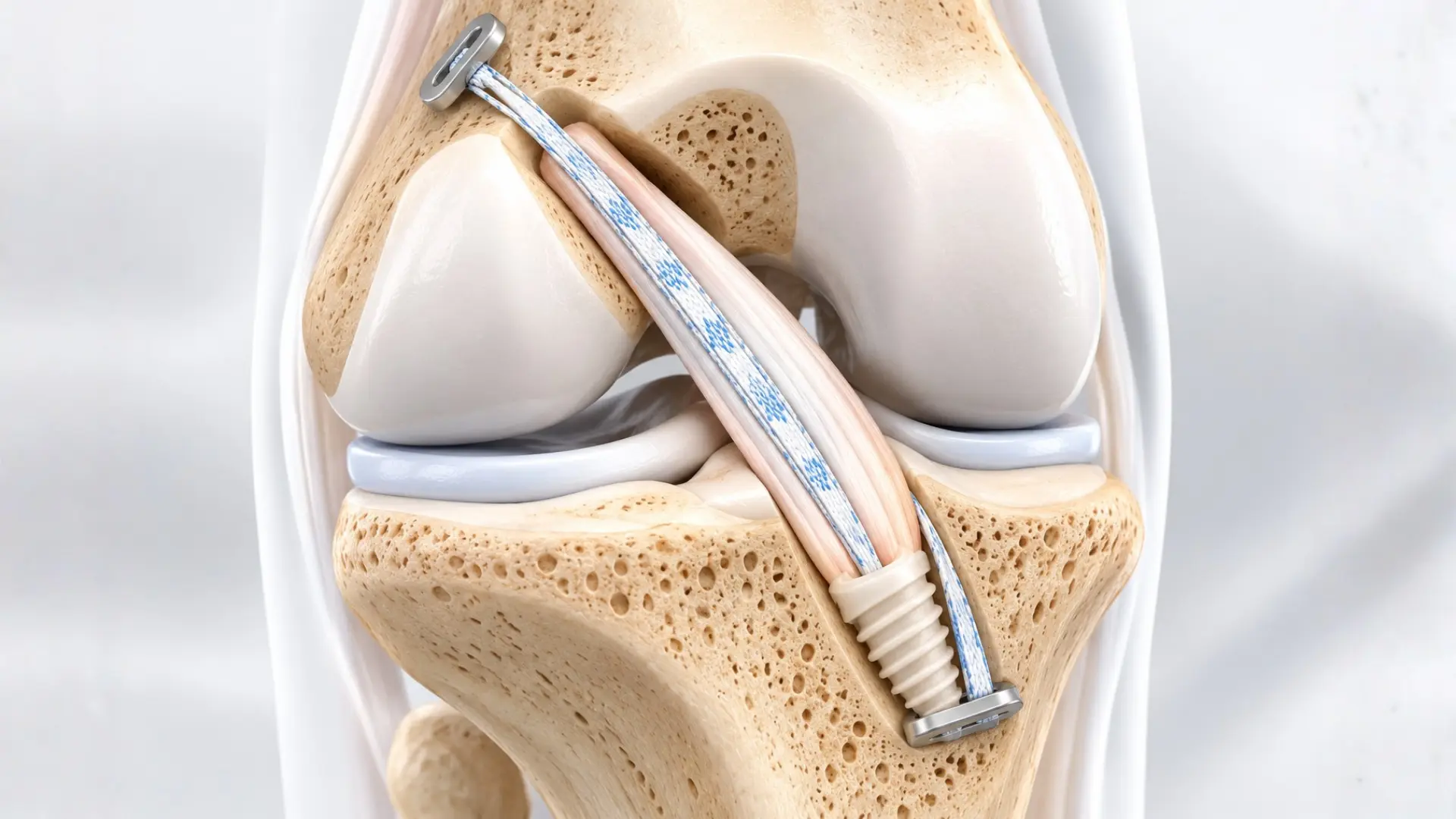
The reason this exists is simple. A new graft is strongest on the day it is fixed. Over the next few weeks the body begins to remodel it into living tissue, and during that phase the graft is temporarily weaker than it was on day one. The tape is there to protect the knee through that window.
The same suture tape idea is also used in a different operation called primary ACL repair, where the patient's own torn ligament is stitched back and supported by the tape. On this page we are talking about augmentation of a reconstruction, where a graft is still used.
Who this technique suits
Usually a good fit
- Young athletes returning to pivoting sport, where re-tear risk is highest
- Revision ACL surgery, where the knee has already failed once
- Cases where the available graft is on the thinner side
- Knees that are naturally loose or hypermobile
- Patients in physically demanding jobs and defence aspirants
May not be needed
- A low demand patient with a good thick graft and a stable knee
- Where the surgeon judges that the added implant brings no real gain
- Any active infection or skin problem around the knee
- Patients who prefer the least possible permanent material in the knee
- Where the extra implant cost outweighs the expected benefit
How the surgery is done
-
01
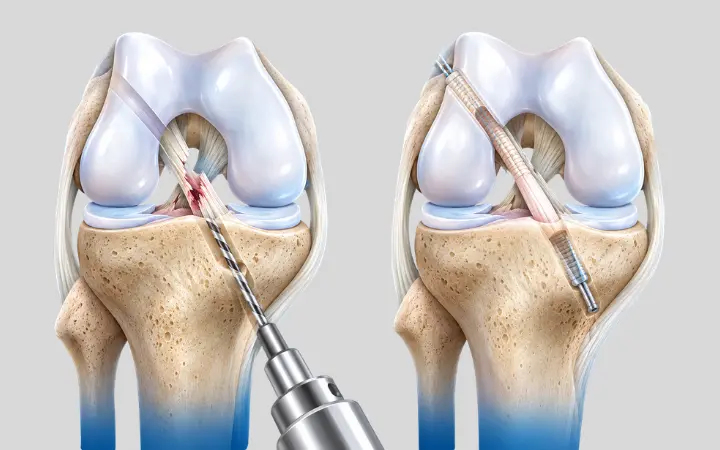
Standard reconstruction is performed
Everything up to this point is the usual operation. The knee is examined, the camera goes in, the graft is harvested and the tunnels or sockets are prepared.
-
02
Tape is loaded alongside the graft
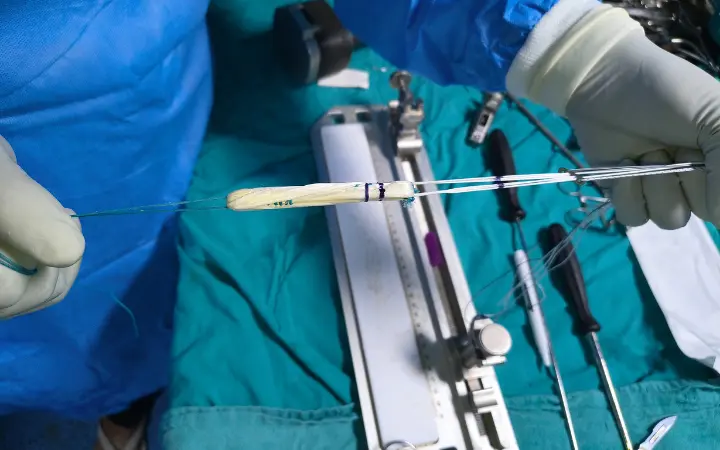
A flat braided suture tape, usually about two millimetres wide, is threaded through the same button that will hold the graft on the thigh bone side. It lies beside the graft, not inside it.
-
03
Graft and tape are passed together
Both are pulled into the knee through the same path. The button flips on the outer surface of the thigh bone and holds the graft and the tape at the top end.
-
04
Tape is anchored on the shin bone
With the knee held straight, the tape is fixed into the shin bone with a small anchor. This is the step that decides everything, because the tape must be snug, never tight.
-
05
Knee is cycled and graft is fixed
The knee is bent and straightened several times to settle the construct. Only then is the graft itself tensioned and fixed, so the graft stays the main load bearer and the tape stays the backup.
-
06
Closure and recovery room
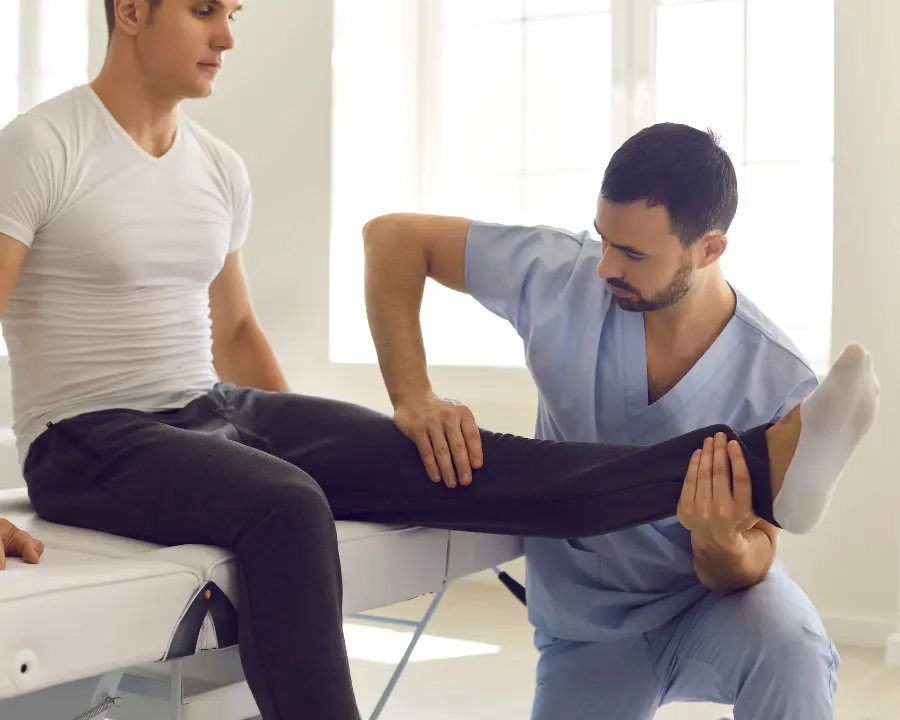
Movement is checked to confirm the knee is not over-tightened. The cuts are closed and physiotherapy usually starts the same day or the next morning.
Tensioning with the knee straight and fixing the tape before the graft is deliberate. If the tape is pulled too tight, it can take load away from the graft or limit full movement, so this step is done with care.
Which graft is used
Internal bracing is an addition, so it can be combined with almost any graft. In fact one of its arguments is that a surgeon may be able to use a slightly smaller graft and take less tissue from your leg.
Hamstring tendon
The most studied combination, and the one where lower failure rates have been reported.
Quadriceps or patellar tendon
Often used in athletes and revision cases, with the tape passed alongside the graft.
Peroneus longus
Can also be braced when the surgeon wants to leave both hamstrings in place.
Recovery at a glance
This is the point most patients get wrong. The brace protects the graft, it does not speed up healing. Your graft still becomes a living ligament on its own timeline, so the milestones and the tests before returning to sport stay exactly the same.
Open the full recovery roadmapBenefits and trade-offs
Benefits
- Protects the graft during the weeks when it is at its weakest
- Reviews of hamstring graft studies report lower failure rates with the tape
- May allow a slightly smaller graft, so less tissue is taken from your leg
- Laboratory testing shows less stretching of the graft under load
- Useful extra security in revision surgery and in loose knees
Trade-offs to know
- An extra implant, so the total cost goes up
- The tape is permanent synthetic material inside the knee
- If tensioned too tightly it can shield the graft or limit movement
- Studies in adolescents have not shown a clear reduction in failures
- Most evidence is short to medium term, so it is an addition, not a guarantee
Put simply, the evidence so far is encouraging rather than settled. A recent pooled review of hamstring graft studies found fewer failures with suture tape and the same complication rate, while other work in younger patients found no clear difference. Your surgeon will weigh your age, sport and graft before recommending it.
Cost of this surgery
Standard reconstruction cost plus the suture tape and anchor used for the brace.
Because the brace is an add-on, the fairest way to look at it is the extra implant cost on top of your reconstruction. Most health insurance policies cover ACL surgery after their waiting periods, and our team can help you with the paperwork.
Common questions
Is the internal brace a wire or a metal rod?
No. It is a flat, soft, braided tape, close to the width of a shoelace tip. It is not metal and it is not visible or felt from outside the knee.
Does the tape replace my graft?
No. The graft is still the new ligament. The tape only shares the load beside it, mainly during the early months. Over time the graft matures and does the work.
Can I return to sport faster because of it?
No, and this is important. The protection is for the healing phase, not a shortcut through it. Return to pivoting sport is still planned around nine months and only after your strength and hop tests are passed.
Will it make my knee feel tight?
It should not. The tape is fixed with the knee straight and deliberately left snug rather than tight, and the knee is moved on the table to confirm full movement before closing.
Does the tape need to be removed later?
Usually not. It is designed to stay permanently, and in published follow-ups patients have not needed surgery to remove the tape or the anchor.
Is it proven to prevent a re-tear?
It lowers the risk in several studies rather than removing it. Pooled results with hamstring grafts show fewer failures, while some studies in teenagers show no clear difference. It is a sensible extra layer for a high risk knee, not a guarantee.
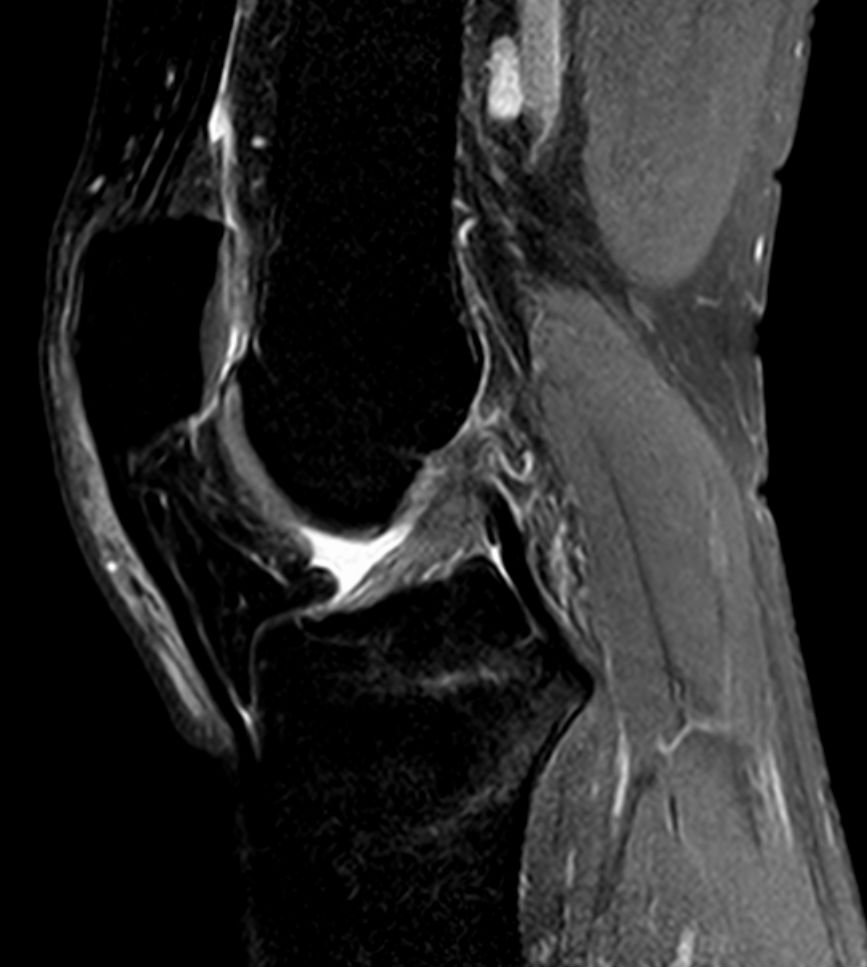
This page explains a surgical technique in general terms. What suits your knee is decided after a clinical examination and MRI review with a leading ACL surgeon in Indore.


Dr. Prince Uchadiya

Thank You,
Patient!
Your appointment request has been received.
Our clinic team will call you shortly to confirm your consultation and share further details.
 Confirm on WhatsApp
