


Which ACL graft is best?
There is no single best graft. Each one borrows strength from a different part of your body, and each leaves something behind. Here is the honest trade-off for all four.

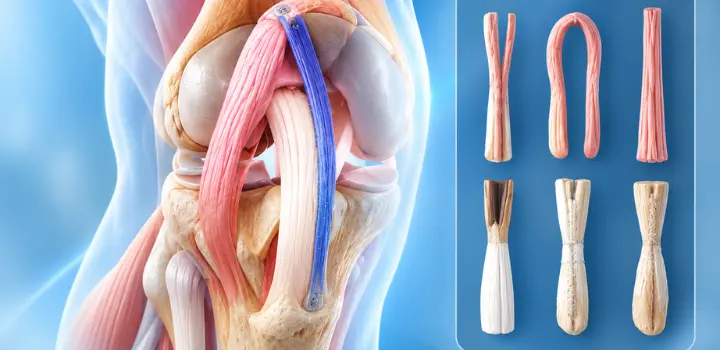
There is no single best ACL graft. Hamstring, peroneus longus, quadriceps and patellar tendon grafts all work, and in large studies the differences in stability and return to sport are smaller than most patients expect.
What differs is what each one costs you at the donor site. One can leave kneeling uncomfortable. One can leave the hamstring slightly weaker. One takes tissue from the ankle instead of the knee. That is the real decision.
And one factor outranks the graft type almost every time: how thick the graft ends up, and how well it is placed. A well positioned graft of adequate diameter beats a theoretically superior graft done poorly.
What a graft actually has to do
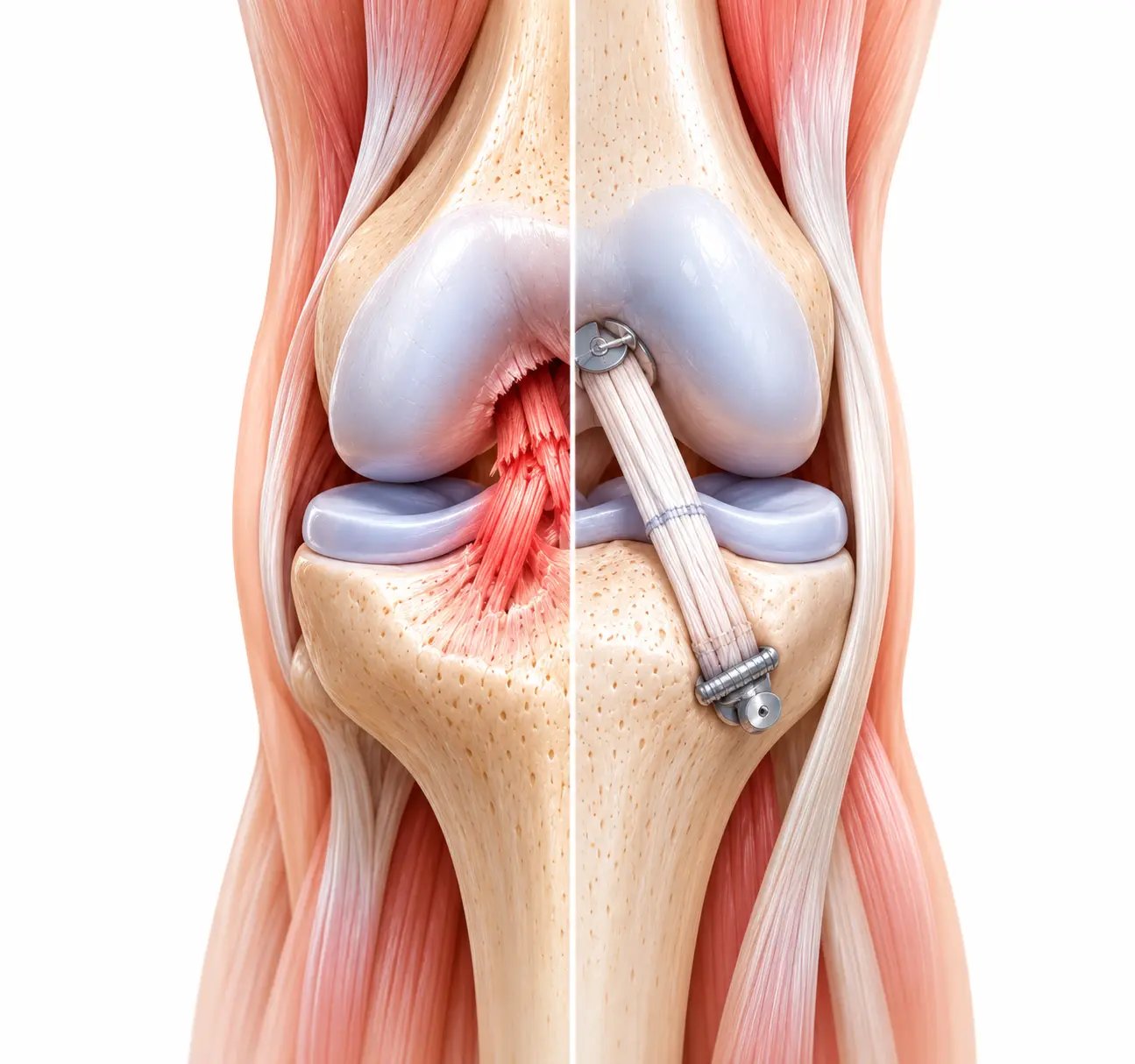
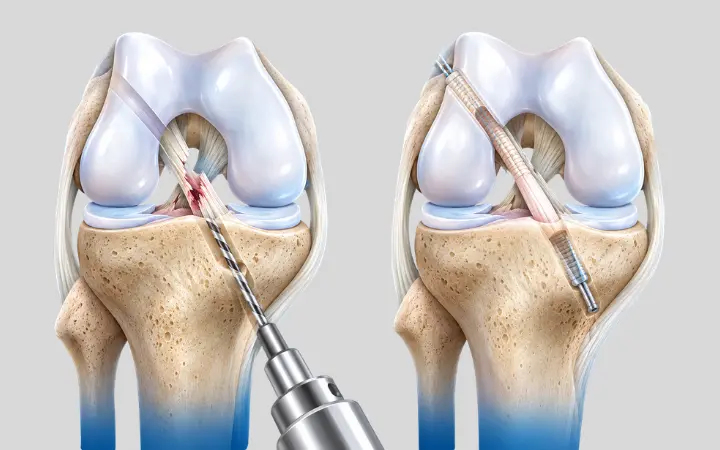
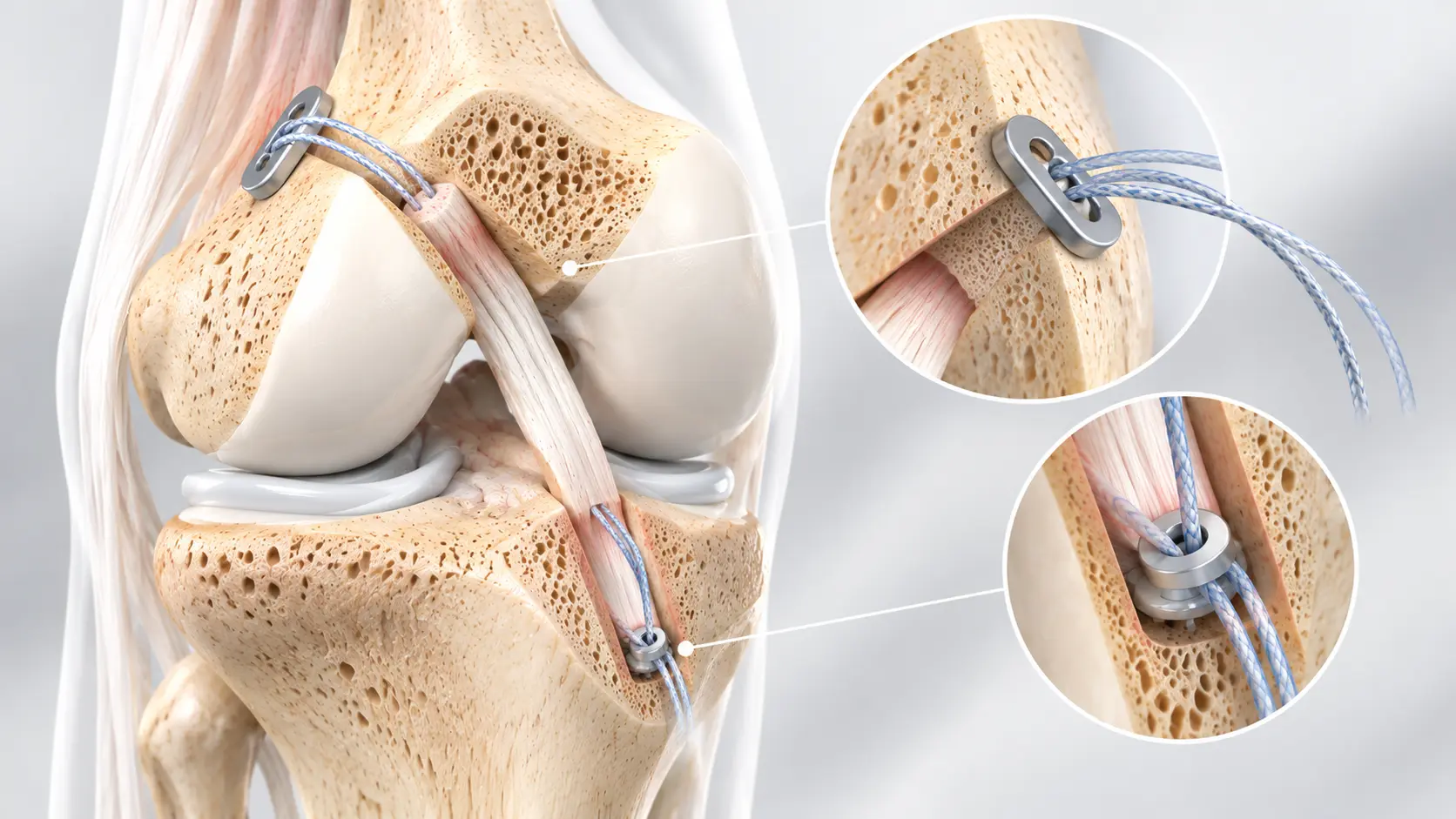
Your torn ACL is not stitched back together in most reconstructions. It is replaced. A tendon is taken from somewhere else in your body, folded or shaped into a cord, and fixed into tunnels drilled through the shin bone and thigh bone in the position the original ligament occupied.
That new cord has to do three things, in this order.
- Be strong enough on day one. Every graft option used today is at least as strong as a healthy ACL at the moment it is fixed in place. Raw strength is not where they differ.
- Survive the weak phase. Between roughly six weeks and six months the graft is being remodelled by your body and is actually weaker than when it was implanted. This is why timelines exist and why returning early is risky with any graft.
- Become living tissue. Over nine to twelve months the body grows blood vessels and cells into the graft and it behaves like a ligament. This happens with all four options.
No graft fails because it was not strong enough on the operating table. They fail from position, from thickness, and from going back too soon.
A note on terms. All four grafts below are autografts, meaning tissue taken from your own body. Donor tissue from a tissue bank is called an allograft, and fully artificial options are synthetic grafts. For most young and active patients in India, autograft remains the standard, and the rest of this article is about choosing between them.
The four grafts, and what each one costs you
Hamstring tendon graft
Two tendons are taken from the inner side of the back of the thigh, through a small incision below the knee, then folded into a four or six strand cord. This is the default graft in most Indian centres and much of the world.
In its favour
- Small incision, less pain in the first weeks
- Kneeling and squatting usually stay comfortable
- No damage to the kneecap tendon or bone
- Reliable, very widely practised technique
What it costs you
- Thickness depends on your anatomy, and a thin graft raises re-tear risk
- Slight long term weakness in deep knee bending strength
- Some numbness over the outer shin is common
- Soft tissue in bone tunnels takes longer to integrate than bone
Peroneus longus tendon graft
A tendon is taken from the outer side of the lower leg, near the ankle, leaving the knee muscles completely untouched. Its use has grown quickly because it reliably gives a thick graft without borrowing anything from the knee.
In its favour
- Consistently good thickness, often better than hamstring
- Knee muscles are left entirely alone, so rehab starts clean
- No kneeling pain and no hamstring weakness
- Useful when both knees are injured or a revision is needed
What it costs you
- Moves the donor site to the ankle, with a second scar there
- Most studies show minor ankle effects only, but long term data is still building
- Needs a surgeon experienced with the harvest
- Less suitable if you already have an ankle problem
Quadriceps tendon graft
Tissue is taken from the thick tendon above the kneecap, with or without a small block of bone. It produces a large, robust graft and has become increasingly popular for revision surgery and for larger or very athletic patients.
In its favour
- Thick and strong, with graft size rarely a problem
- Hamstrings stay intact, which helps sprinting athletes
- Less kneeling pain than patellar tendon graft
- A strong option when a first reconstruction has failed
What it costs you
- Quadriceps strength takes longer to come back, and rehab must be disciplined
- Slightly larger scar above the kneecap
- Some early discomfort at the front of the knee
- Technically demanding to harvest well
Patellar tendon graft
The middle third of the tendon below the kneecap is taken with a block of bone at each end. Because bone heals to bone faster than tendon heals to bone, it fixes very securely, and for decades it was considered the reference standard for elite athletes.
In its favour
- Bone to bone healing inside the tunnels, which is fast and secure
- Excellent stability, long track record in pivoting sport
- Graft size is predictable
- Often preferred for high level contact athletes
What it costs you
- Kneeling discomfort is clearly more common than with hamstring graft
- More pain at the front of the knee in early recovery
- Small risk of kneecap problems where bone was removed
- Not ideal for patients who kneel or sit on the floor daily
Side by side comparison
Scroll the table sideways to see all columns.
| Graft | Donor site | Main strength | Main drawback |
|---|---|---|---|
| Hamstring | Back of thigh | Comfortable kneeling, small scar, widely proven | Thickness varies with your anatomy |
| Peroneus longus | Outer lower leg | Good thickness, knee left untouched | Donor site moves to the ankle, newer evidence base |
| Quadriceps | Above kneecap | Large graft, hamstrings preserved | Slower quadriceps strength recovery |
| Patellar tendon | Below kneecap | Bone to bone healing, strong track record | Kneeling discomfort, more front of knee pain early |
Read that table as a list of trade-offs, not a ranking. Every row is a reasonable choice for the right patient, and the bottom row is still the first choice for some elite athletes despite its drawback.
What matters more than the graft you pick
Patients spend a lot of energy on this choice, and surgeons often spend more on these three things instead, because the evidence points there.
Graft thickness
In a large registry study of more than eighteen thousand hamstring reconstructions, grafts under about eight millimetres in diameter were linked to a higher chance of needing revision surgery later. Every extra millimetre mattered. This is the single most consistent graft related finding in the literature, and it is also the reason a surgeon may switch plan during surgery if the harvested tendon turns out thinner than expected.
Tunnel position
The graft has to sit where the original ligament sat. A graft placed even slightly off that footprint does not control rotation properly, no matter which tendon it came from. This is surgical technique, and it is the part of the operation that most affects your outcome.
What you do in the twelve months afterwards
Returning to sport before the graft has matured, and before strength and hop testing are passed, is the largest avoidable risk factor for re-tear. Graft choice cannot compensate for going back at five months because the knee felt fine.
A surgeon who has done a particular graft hundreds of times will usually get you a better result with that graft than with the one an article called superior. Experience with the technique is part of the decision, not a compromise.
Kneeling, squatting and floor sitting
This deserves its own section, because it is routinely underweighted in articles written for Western patients and it matters a great deal here.
In a national registry study of nearly eleven thousand reconstructions, severe difficulty with kneeling was reported by around 21 percent of patellar tendon graft patients compared with around 9 percent of hamstring graft patients. Overall knee pain scores were similar between the groups. The difference was specifically in kneeling.
Now think about daily life in India. Sitting cross legged on the floor. Indian style toilets. Namaz. Pooja. Squatting at work. Playing with children on the ground. Farm and construction work. If any of that is part of your week, the kneeling difference stops being a footnote and becomes one of the main inputs into your decision.
Do not assume it will be asked. Say plainly whether you sit on the floor, kneel for prayer, or squat at work. It can reasonably shift the choice away from a patellar tendon graft toward hamstring, peroneus longus or quadriceps.
How your surgeon should choose
A reasonable graft decision takes these inputs together, and you should hear the reasoning rather than just the conclusion.
- Your sport and your work. Pivoting contact sport, sprinting, heavy manual work and desk work all pull in slightly different directions.
- Whether you kneel, squat or sit on the floor. Covered above, and often decisive.
- Your build and likely graft thickness. Slimmer patients are more likely to yield a thin hamstring graft, which can favour peroneus longus or quadriceps.
- Whether this is a first or a repeat surgery. For revision surgery, the first graft is gone, so quadriceps and peroneus longus come to the front.
- Other injuries in the same knee. A meniscus repair or a second ligament changes the plan and sometimes the graft.
- What your surgeon does most. Honest and legitimate. Ask them directly which graft they use most and why.
If you want the detail on any single option, each one has its own page: hamstring, peroneus longus, quadriceps and patellar tendon.
Common questions
Which graft has the lowest re-tear rate?
Across large studies the differences are smaller than the marketing around individual grafts suggests. Patellar tendon and quadriceps grafts show slightly lower re-tear rates than hamstring in some athlete populations, but graft thickness, tunnel position, age and return to sport timing influence the result more than the choice of tendon. A thin hamstring graft carries more risk than a thick one, which is why your surgeon measures it during the operation.
Does taking the hamstring tendon leave me permanently weaker?
The tendons regenerate to a degree over the following year, and most patients return to full function. What testing often shows is a small persistent deficit in strength at deep knee bend angles. For daily life and most sport this is not noticeable. For sprinting athletes it is a genuine consideration, and it is one reason quadriceps or peroneus longus grafts are sometimes chosen instead.
Is taking a tendon from my ankle safe?
Studies of peroneus longus harvest generally report only minor effects on ankle function, because a neighbouring tendon takes over much of the work. Most patients walk and run normally. The caveats are that the long term data is still accumulating compared with decades of hamstring and patellar experience, and that it is less suitable if you already have ankle instability or a previous ankle injury.
Should I ask for a donor graft instead of using my own tissue?
For young, active patients, donor tissue carries a clearly higher re-tear rate and is generally not recommended. It has a role in older or lower demand patients, in multi-ligament surgery, and in some revision cases where there is not enough of your own tissue left. It is also more expensive and depends on tissue bank availability, which is limited in much of India.
What about synthetic or artificial ligaments?
Fully synthetic ACL replacements have a difficult history. Earlier generations failed at high rates and caused inflammation inside the joint, and they are not standard treatment today. Newer devices used to support a biological graft are a different concept. If a synthetic option is being proposed to you, ask specifically which device, what the published failure rate is, and why it is better than your own tendon in your case.
Does the graft choice change my recovery timeline?
Only at the margins. The overall timeline is set by biology, roughly nine to twelve months for the graft to mature, and that applies to all of them. Patellar tendon graft tends to need more early work on front of knee pain. Quadriceps graft needs more focused quadriceps strengthening. Hamstring graft needs attention to hamstring strength. The destination is the same, the early weeks differ.
Can the plan change during surgery?
Yes, and you should expect to be told about this beforehand. The most common reason is that the harvested hamstring turns out thinner than expected, in which case the surgeon may add tissue or switch to another graft. Agreeing a plan B before you go in is better than discovering it afterwards.
What should I ask my surgeon about the graft?
Four questions. Which graft are you planning for me and why that one for my knee? What diameter are you expecting, and what is the plan if it comes out thin? Given that I kneel and sit on the floor, does that change your choice? And which graft do you personally do most often?
- Snaebjornsson T et al. Graft diameter as a predictor for revision anterior cruciate ligament reconstruction, registry analysis of 18,425 patients.
- New Zealand ACL Registry. Kneeling ability and patient reported outcomes after ACL reconstruction by graft type, analysis of 10,999 reconstructions.
- Systematic reviews and meta-analyses comparing hamstring, bone-patellar tendon-bone, quadriceps and peroneus longus autografts for anterior cruciate ligament reconstruction.
Dr. Prince Uchadiya, a top arthroscopic ACL surgeon in Indore, performs keyhole ACL reconstruction using hamstring, peroneus longus, and quadriceps grafts, and selects the graft after discussing the patient's sport, work and daily movements rather than applying one technique to everyone.
This article is for general information and does not replace an in person examination. Graft selection should be decided with a surgeon who has examined your knee, reviewed your scans and understood what you need the knee to do.