
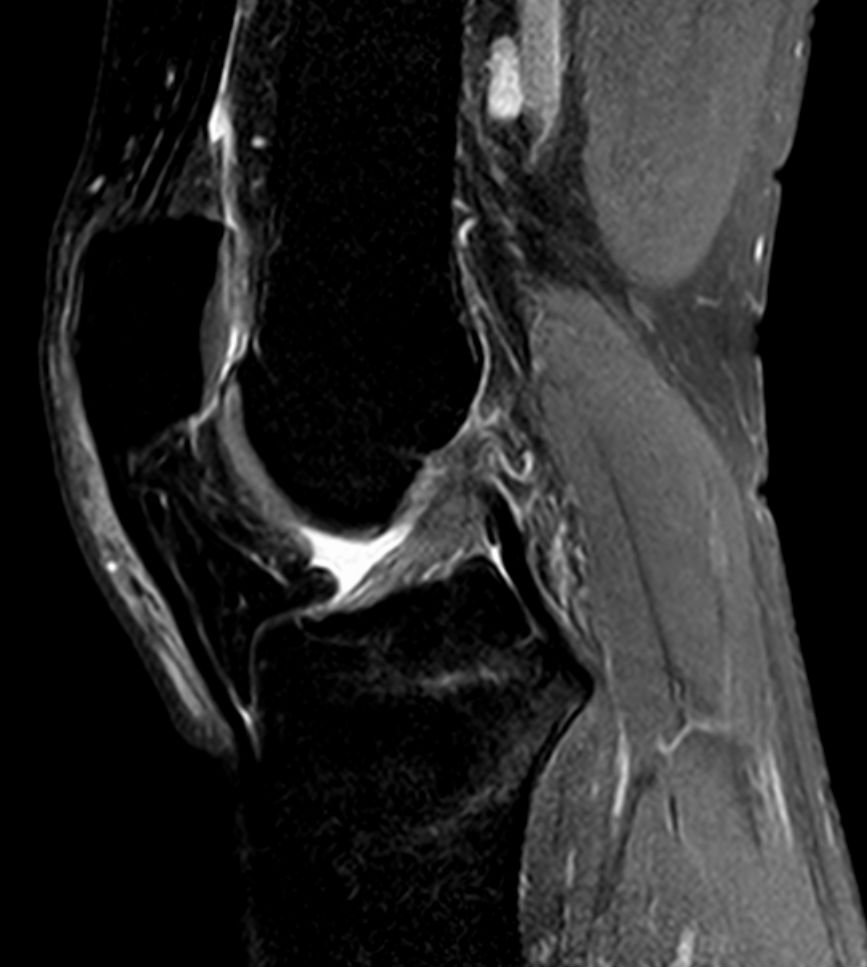

Patellar Tendon Graft
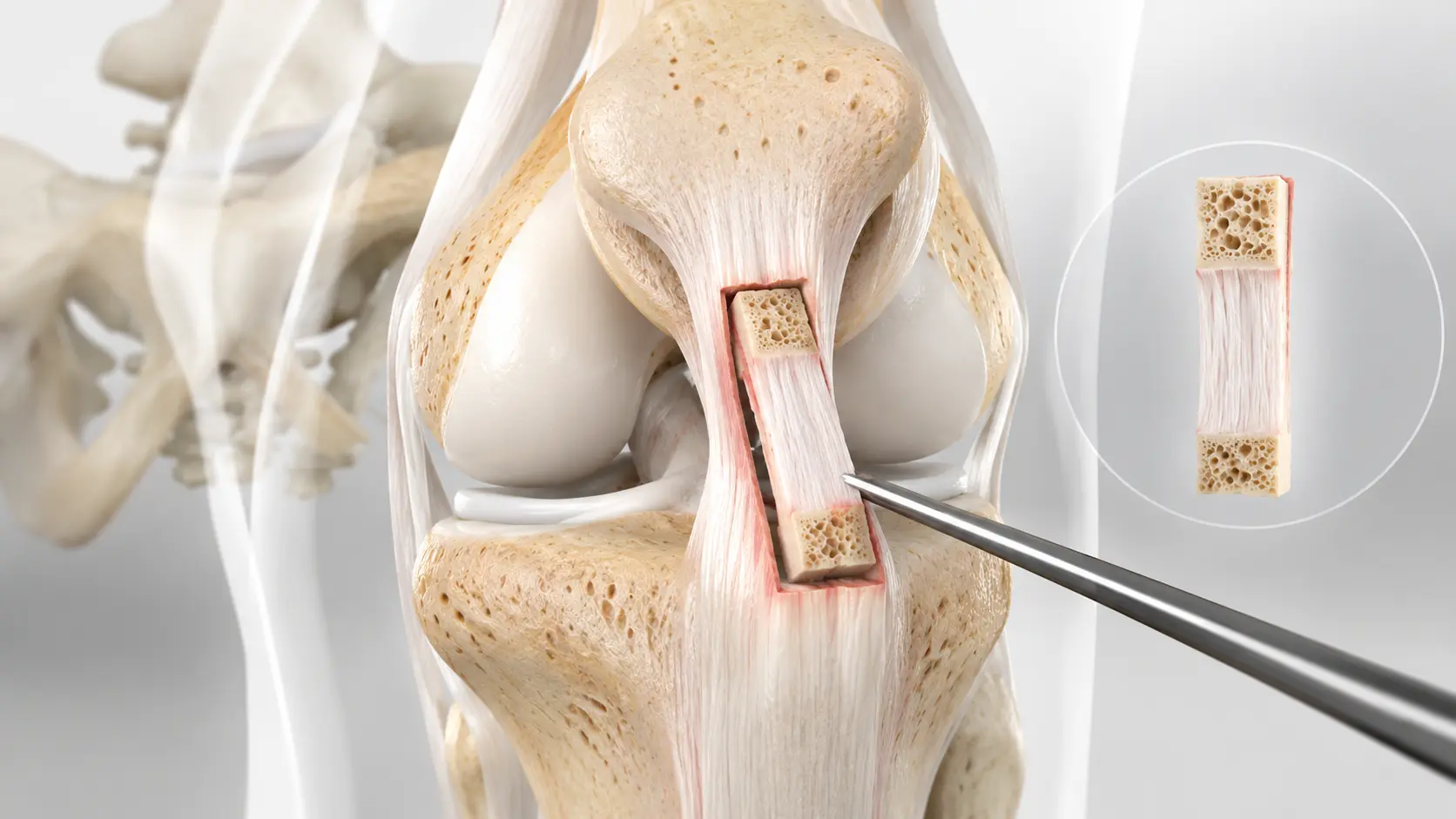
The long standing benchmark graft for high level athletes. A strip of the tendon below your kneecap is taken with a small block of bone at each end, so the graft heals bone to bone inside the tunnels.
Animation or OT footage showing the bone, tendon, bone graft being taken and prepared.
What is a patellar tendon graft?
Below your kneecap runs the patellar tendon, the band you can feel when you straighten your leg. The middle third of it is taken, along with a small rectangle of bone from the kneecap at the top and from the shin bone at the bottom.
This graft is often called the gold standard, and the label is half earned. For decades it was the reference against which every other graft was measured, and in young athletes returning to pivoting sport it still shows some of the lowest re-tear rates.
But it carries a specific cost that the other grafts do not, and it is not pain in general. Large registry data shows patients with this graft do not end up with a more painful knee overall. What they do end up with, far more often, is a knee that is uncomfortable to kneel on.
Who this graft suits
Usually a good fit
- Competitive and professional pivoting athletes
- Young patients at high risk of a second tear
- Those whose priority is the lowest possible re-tear risk
- Revision surgery needing strong, reliable fixation
- Patients whose work and sport do not involve kneeling
May not be the first choice
- Anyone who kneels regularly for work, prayer or floor seating
- Existing kneecap pain or patellar tendon problems
- Growing children, since bone blocks cannot cross growth plates
- Wrestlers, plumbers, electricians, carpenters and similar trades
- Patients who want the smallest possible scar at the front
How the graft is taken
-
01
A cut down the front of the knee
A vertical cut is made over the tendon between the kneecap and the shin bone. This is the longest harvest scar of the common grafts.
-
02
The middle third is marked
A strip about nine to ten millimetres wide is marked in the centre of the tendon, leaving strong tendon on either side.
-
03
Bone blocks are cut
A small rectangle of bone is cut from the kneecap and another from the shin bone, each still attached to the tendon strip. The cuts are kept shallow and the corners rounded, which is what reduces the risk of the kneecap cracking.
-
04
Blocks are shaped and sized
On the back table the bone blocks are trimmed to pass smoothly through the tunnels, and holes are drilled in them for the stitches.
-
05
The donor site is closed
The gap in the tendon is stitched and the bone defects are often filled with the bone dust collected during drilling. How well this is done affects front of knee comfort later.
-
06
Graft is loaded and placed
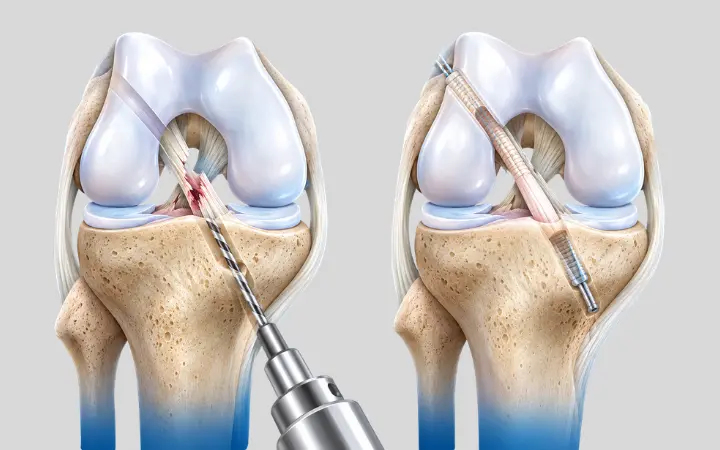
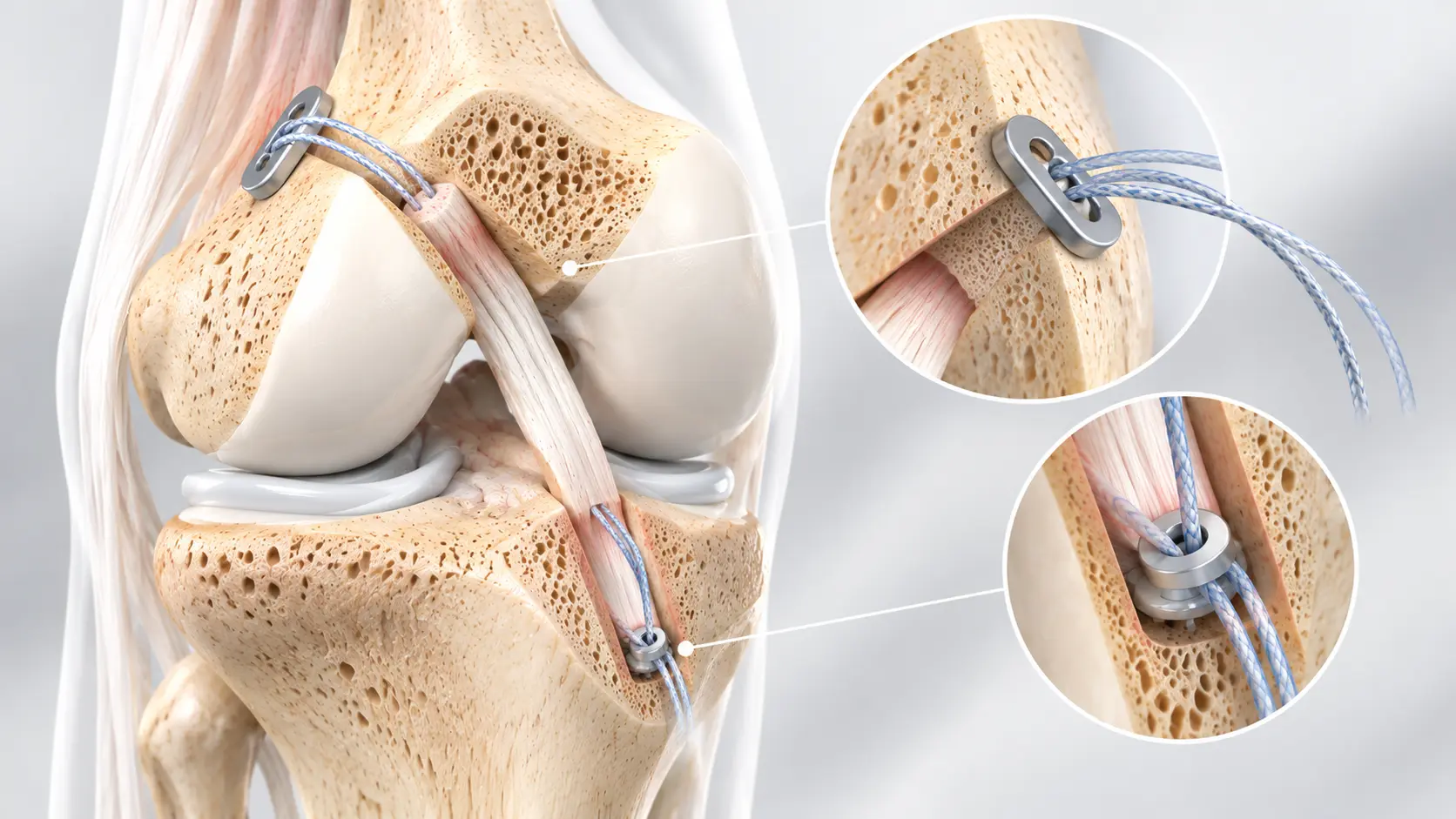
The graft is passed into the tunnels so that a bone block sits in each one, and is usually fixed with interference screws that press bone against bone.
The two uncommon but serious risks here both relate to the bone cuts. A crack in the kneecap, and a rupture of the remaining tendon. Both are rare, and both are reduced by shallow cuts with rounded corners and by careful closure of the donor site.
Why surgeons trust this graft
The strength argument here is not mainly about the tendon. It is about the ends. A bone block pressed into a bone tunnel knits like a fracture, and that union is quicker and more predictable than soft tendon growing into the wall of a tunnel.
Bone to bone union
The fastest and most direct healing of any graft option.
Predictable width
Nine to ten millimetres in most patients, decided by the strip, not by folding.
Strong fixation
Screws press bone against bone, giving a very secure hold from day one.
Comparative studies back this where it matters most. In high risk groups, meaning young patients returning to pivoting sport, this graft has shown lower re-rupture rates than hamstring grafts. In lower risk patients, the patient reported outcomes between the two are broadly comparable, which is exactly why the choice depends on who you are rather than on which graft is better in the abstract.
Compare all graft and implant typesRecovery at a glance
Two things define recovery with this graft. Quadriceps strength is slow to return, because the tendon that drives straightening has been cut into, so thigh muscle work starts in week one and stays central throughout. And the front of the knee is tender over the scar for months, which is normal rather than a sign of a problem.
Kneeling is introduced late and gradually. Do not test it early to see how it feels, because the tenderness at that stage tells you nothing about how it will settle.
Open the full recovery roadmapBenefits and trade-offs
Benefits
- Bone to bone healing, faster and more predictable than tendon to bone
- Lower re-rupture rates in young high risk athletes
- Very secure fixation from the first day
- Hamstrings are left completely untouched
- The longest track record of any ACL graft
Trade-offs to know
- Kneeling difficulty is far more common than with a hamstring graft
- Slow return of quadriceps strength
- A longer scar down the front of the knee
- Small but real risks of kneecap crack or tendon rupture
- Not suitable for growing knees, because of the bone blocks
The clearest data on this comes from a registry of almost eleven thousand reconstructions. Severe difficulty with kneeling was reported by about twenty one percent of patellar tendon patients against about nine percent of hamstring patients, roughly three times the odds. Yet overall knee pain scores were nearly identical between the two groups. So the honest framing is not that this graft gives you a painful knee. It is that it gives you a knee that often objects to being knelt on.
In Indian life that distinction matters a great deal, because kneeling, squatting and floor seating are part of daily routine, prayer and many trades. For a competitive athlete it may be a price worth paying. For a plumber or someone who sits on the floor every day, another graft usually serves better.
Cost of this graft
Your reconstruction cost. The graft is your own tissue, so there is no separate graft charge.
Fixation for this graft is usually with interference screws, which are often less expensive than the button systems used with soft tissue grafts. Most health insurance policies cover ACL surgery after their waiting periods, and our team can help you with the paperwork.
Common questions
Will I be able to kneel and sit on the floor afterwards?
Most patients can, but discomfort when kneeling is clearly more common with this graft. In registry data about one in five patients reported severe difficulty kneeling, compared with about one in ten after a hamstring graft. If your day involves kneeling, prayer on the floor or squatting work, say so before the graft is chosen.
Is it really the gold standard?
It was the reference graft for decades and still performs excellently, particularly in young pivoting athletes where it shows lower re-tear rates. Newer options now match it on many measures with less kneeling trouble, so the title is no longer automatic.
Why would bone be taken from my kneecap?
So that the graft has bone at both ends. Bone knits to bone inside the tunnel the way a fracture heals, which is quicker and more predictable than tendon healing to bone.
Could my kneecap crack?
It is an uncommon complication. The bone cuts are kept shallow with rounded corners specifically to avoid it, and the defect is usually filled afterwards.
Will the scar be large?
It is the longest of the common harvest scars, running down the front of the knee. It fades over time but stays more visible than a hamstring scar.
Can my child have this graft?
Usually not while growth plates are still open, because the bone blocks cannot safely cross them. Soft tissue grafts are used instead in growing knees.
This page explains a graft option in general terms. Which graft suits your knee is decided after an examination, MRI, and sport-demand discussion with an ACL surgeon in Indore.

Dr. Prince Uchadiya

Thank You,
Patient!
Your appointment request has been received.
Our clinic team will call you shortly to confirm your consultation and share further details.
 Confirm on WhatsApp
