


Is an internal brace worth it?
A strong tape runs alongside your graft to protect it while it heals. The idea makes sense. Here is what the evidence actually shows, what it costs, and who it genuinely helps.

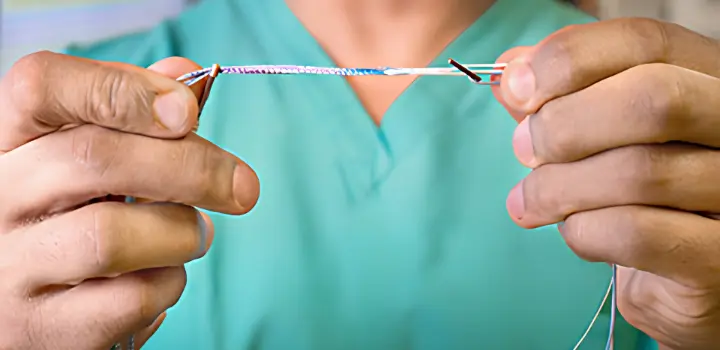
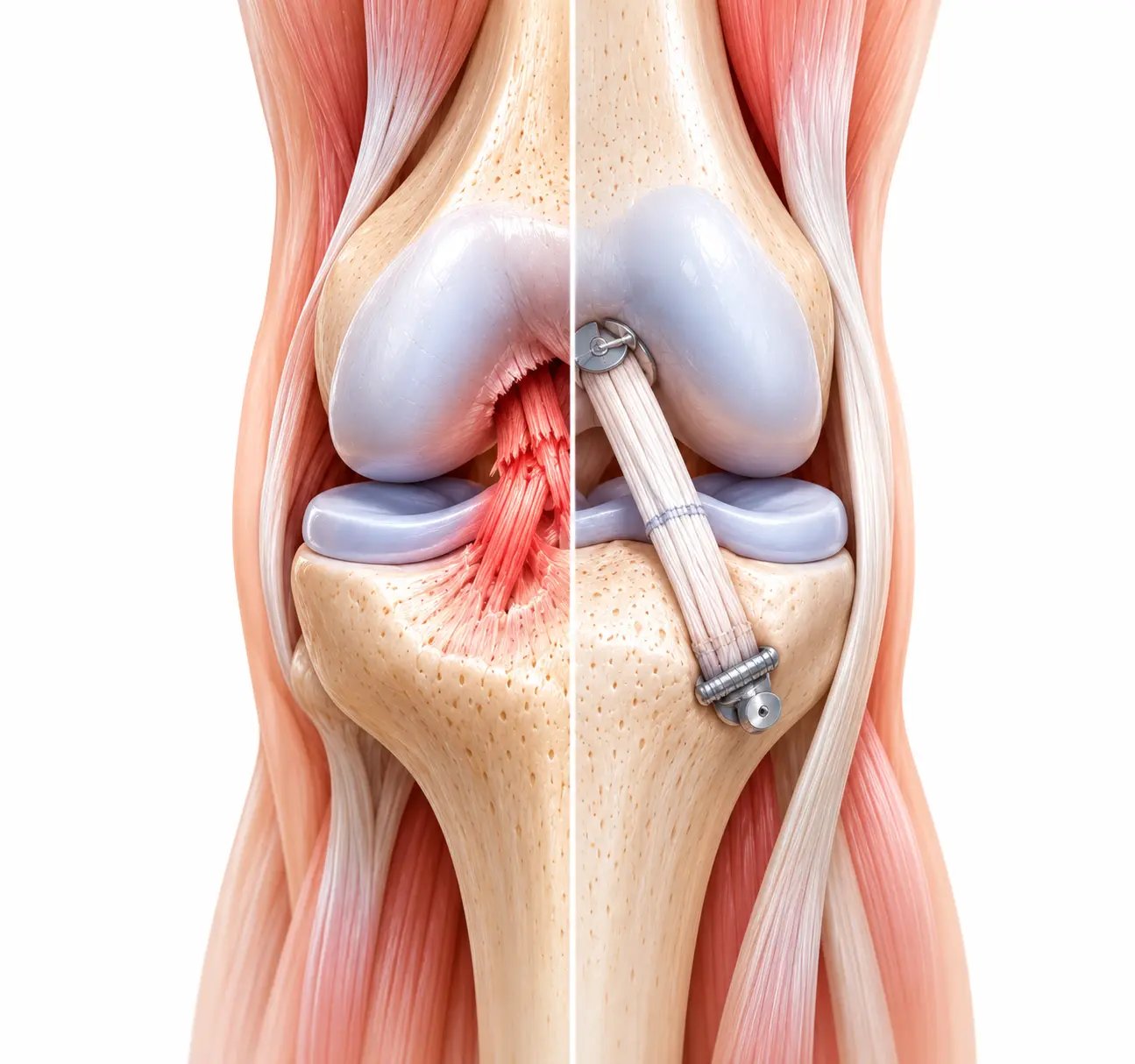
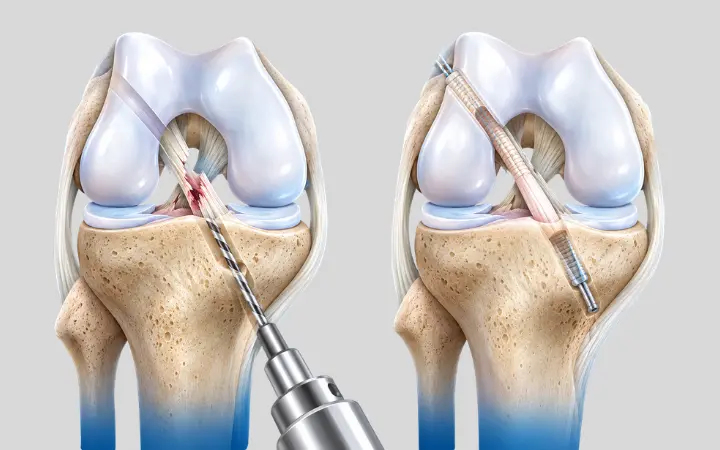
An internal brace is a high strength suture tape fixed alongside your graft, so that it shares the load during the months when the graft is at its weakest. It is an add-on, not a different operation.
The honest position on the evidence: studies point in a favourable direction but have not proved a clear reduction in re-tear rates. Patient reported scores are often slightly better. The studies are small, and the follow-up is short.
So it is reasonable for some patients, particularly revision surgery, primary repair and thin grafts. It is not something every ACL patient needs, and it does not shorten rehabilitation by a single week.
What an internal brace actually is
The name causes confusion, so start here. An internal brace is not a brace you wear. Nothing goes on the outside of your leg. The word brace refers to what the tape does inside the joint.
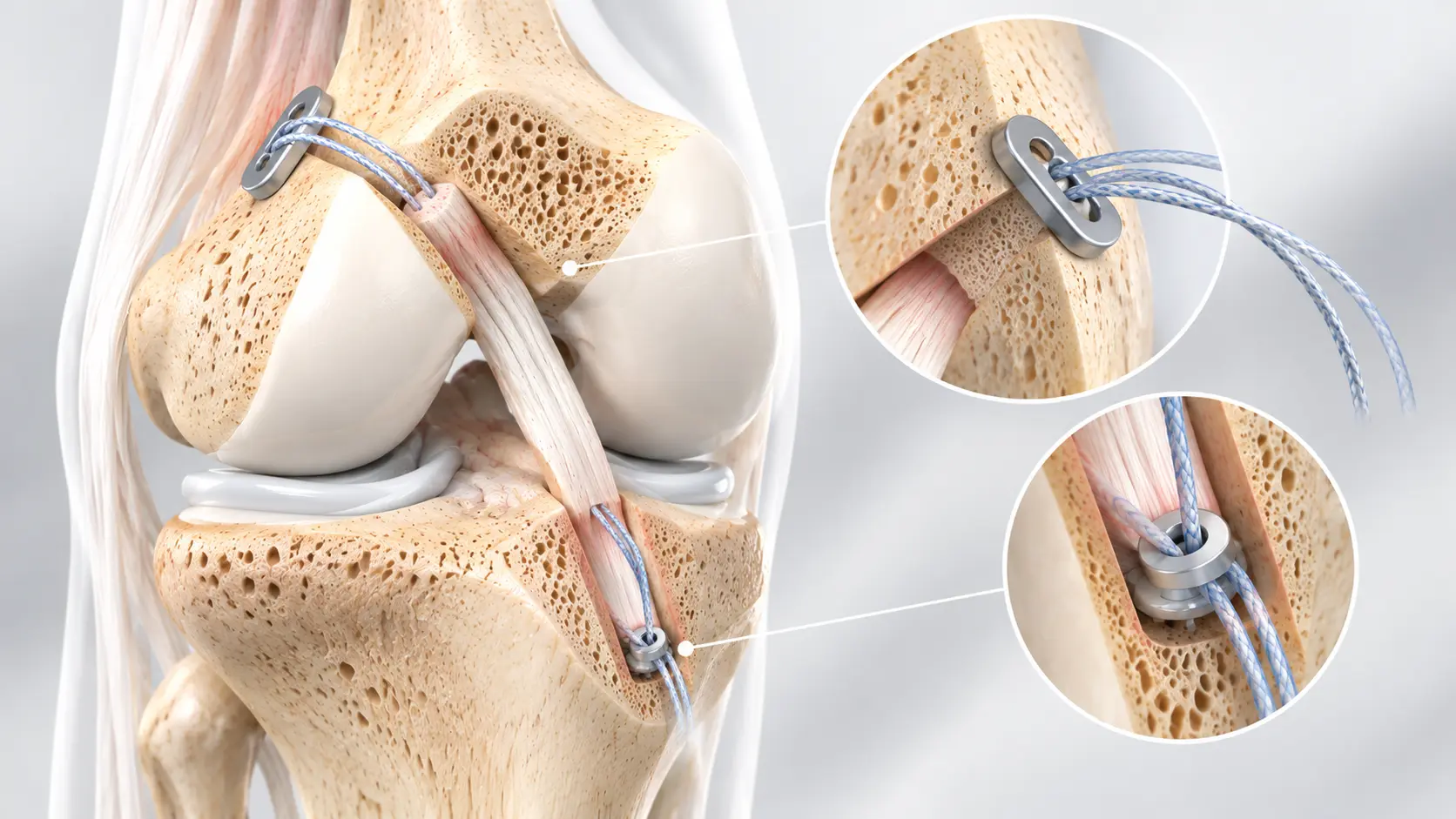
During reconstruction, after the graft is passed through the bone tunnels, a flat high strength tape is passed alongside it and anchored into the same bone. The graft and the tape then run in parallel. The tape is deliberately left with a small amount of slack, so that in normal movement the graft takes the load, and the tape only tightens if the knee is pushed toward the range where the graft could be overstretched.
Think of it as a safety rope rather than a second ligament. You find out it was there only when something goes wrong.
It is a backup that stays slack most of the time, not a replacement that carries the knee.
The same idea is used in several places. Alongside a graft in internal brace augmentation, as the main support in primary ACL repair, and in ligament surgery around the ankle and the inner side of the knee. You may also hear it called suture tape augmentation, which is the term used in the research.
The problem it is trying to solve
A new graft is not weakest on the day it goes in. It is strongest then. What happens next is the reason the internal brace exists.
That middle column is the whole argument. Around the time patients start feeling confident, walking normally and getting impatient, the graft is quietly at its most vulnerable. Most graft failures happen in this window, often from a twist or a stumble rather than sport.
The tape is meant to carry the peak loads during those months, so the graft is not stretched out while it is remodelling. It is a sound idea on paper, and that is exactly why it needs to be checked against outcomes rather than accepted on logic alone.
What the evidence shows
Laboratory testing is clear and consistently favourable. Augmented grafts stretch less and tolerate more cycles of loading before they loosen. The question is whether that translates into fewer re-tears in real patients.
What the clinical studies found
One meta-analysis pooling four studies and 289 patients found graft failure odds of 0.41 with suture tape augmentation. That number leans in favour of the tape, but it did not reach statistical significance, which in plain terms means the result could still be chance. The same analysis did find significantly better scores on several patient reported measures, and no difference in return to sport rates.
A separate systematic review of five studies, 246 augmented patients against 282 controls, reached a blunter conclusion. It is titled around the phrase insufficient evidence. Graft failure ranged from 1 to 25 percent in the augmented groups and 8 to 20 percent in the controls. The ranges overlap heavily, which tells you more about how variable the studies are than about the tape.
More recent pooled analyses have been somewhat more positive, suggesting reduced re-rupture and improved return to sport. The field is moving, and the direction of travel is mildly encouraging.
There is no strong randomised evidence that an internal brace prevents re-tears. There is reasonable evidence that it does not harm, and that patients report slightly better function. Anyone presenting it as proven protection is ahead of the data.
The open questions, including stress shielding
The case for
- Protects the graft through the known weak window
- Laboratory data on reduced stretching is consistent
- Patient reported function scores trend better
- Particularly logical when the graft is thin or the tissue is poor
- Adds very little operating time
The case against
- No clear proof of fewer re-tears in randomised trials
- Stress shielding is a real theoretical concern
- Extra implant cost, usually not separately covered
- A permanent synthetic material stays inside the joint
- Long term follow-up data is still thin
Stress shielding, explained simply
Biological tissue strengthens in response to the loads placed on it. That is why bone thickens with training and why muscles grow. The worry with an internal brace is the reverse. If the tape carries too much of the load, the graft may receive too little stimulus to remodel into strong ligament tissue. You would then have a knee that feels stable early, supported partly by a synthetic tape, with a graft underneath that never fully matured.
This is why surgeons deliberately leave the tape slightly slack rather than tight. Whether stress shielding actually matters in practice is not settled, and it is one of the main reasons the technique has not simply become routine for everyone.
Who it suits, and who does not need it
The useful question is not whether internal bracing works in general, but whether it adds anything for your particular knee.
Situations where it makes most sense
- Revision surgery. The first graft already failed, bone tunnels may be widened, and the margin for error is smaller.
- A thinner graft than planned. If the harvested tendon comes out below the diameter the surgeon wanted, the tape is a sensible way to shore it up.
- Primary ACL repair. Here the tape is not an extra, it is central to the technique, because your own torn ligament needs protection while it heals.
- A knee with extra laxity. Some patients are naturally very flexible, and their soft tissue stretches more under load.
- High demand athletes. Where an early re-tear would be particularly costly, some surgeons prefer the additional margin.
Situations where it probably adds little
- A first time reconstruction, with a good thick graft, in a patient with normal tissue quality
- A patient returning to straight line fitness rather than pivoting sport
- Any situation where the real risk is going back to sport too early, which the tape does not fix
- Any case where the added cost is a genuine strain on the family budget
Put it to your surgeon directly: what specifically about my knee makes you want to add this, and what would change if we left it out? A good answer names something about your graft, your tissue or your history. A vague answer about it being the latest technique is not a reason.
Cost, and what it does not change
The tape and its anchors are additional implants, so they add to the implant bill, typically in the range of ₹ 20,000 to ₹ 30,000 on top of the reconstruction. Insurance cover for implants varies by policy, and the augmentation is not always itemised separately, so it is worth asking for the figure in writing before surgery rather than discovering it at discharge.
Now the part that matters more than the cost. Here is what an internal brace does not do.
- It does not shorten your rehabilitation. The graft still takes nine to twelve months to mature. Timelines are set by biology, not by hardware.
- It does not let you return to sport earlier. Return is decided by strength testing, hop symmetry and control, exactly as it would be without the tape.
- It does not compensate for weak quadriceps. No implant replaces the muscle work that actually protects a knee.
- It does not fix a badly positioned graft. Tunnel position remains the most important technical factor in the operation.
If the tape is being offered as a way to get back to the field sooner, that is the wrong reason to say yes.
Common questions
Is an internal brace something I wear on my leg?
No. Despite the name, nothing goes on the outside. It is a strong tape placed inside the knee alongside the graft during the operation and anchored into bone. You may still be given an external knee brace to wear after surgery, but that is a completely separate thing.
Does it stay in my knee forever?
Yes. The tape is a permanent synthetic material and is not removed. In the large majority of patients it causes no problems and is never noticed. It is one of the reasons the decision deserves a proper conversation rather than being added by default.
Will it set off metal detectors or show on a scan?
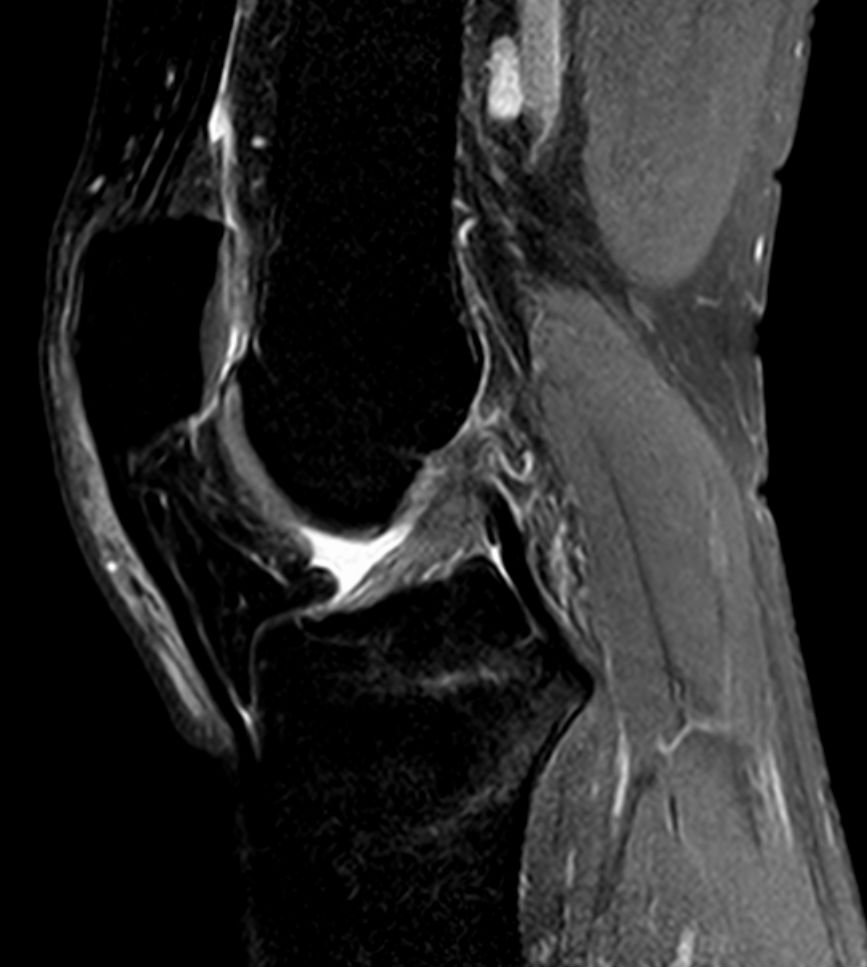
The tape itself is not metal. The anchors holding it may be metal or absorbable depending on what your surgeon uses. Neither causes problems at airport security in practice. Implants do show up on X-rays and can create some local distortion on MRI, which is normal and expected.
If it protects the graft, why is it not used for everyone?
Three reasons. The evidence has not yet shown a clear reduction in re-tears. There is a theoretical concern that taking load off the graft may slow its own maturing. And it adds cost and a permanent implant for a benefit that is still being measured. Surgeons who use it selectively rather than routinely are reading the evidence accurately, not being conservative.
My surgeon did not mention it. Should I be worried?
No. A standard reconstruction with a good graft, well placed, remains the most proven operation for an ACL tear. The absence of an internal brace is not a sign of outdated practice. If you want to understand the reasoning, simply ask whether it was considered in your case and why it was not chosen.
Is it the same as a synthetic ligament?
No, and this distinction matters. A synthetic ligament attempts to replace the ACL entirely with artificial material, an approach with a troubled history of failure and inflammation. An internal brace supports your own biological graft while it heals, with the graft still doing the main job. They are different concepts with very different track records.
Does it change my recovery plan week by week?
Most surgeons run the same protocol either way, and that is the safer approach given the current evidence. Some allow slightly faster early progression. What should never change is the criteria for returning to sport, which stay based on strength and hop testing rather than on the calendar or on what was implanted.
What should I ask before agreeing to it?
Four questions. What about my knee specifically makes you recommend it? What is the total additional cost, including the anchors? Does my rehabilitation or my return to sport timeline change at all? And what is your own experience of outcomes with and without it?
- Aryana IGNW et al. Suture tape augmentation in anterior cruciate ligament reconstruction, systematic review and meta-analysis of four studies and 289 participants.
- Insufficient Evidence for Anterior Cruciate Ligament Reconstruction Utilizing Suture Tape Augmentation, a Systematic Review of Clinical Outcomes at Minimum 1-Year Follow-Up, five studies, 246 augmented and 282 control patients.
- Systematic review and meta-analysis of synthetic augmentation in ACL reconstruction and its effect on re-rupture and return to sport rates.
- Biomechanical studies of graft elongation and cyclic loading with and without suture tape augmentation.
Dr. Prince Uchadiya, a trusted ACL surgeon in Indore, uses internal brace augmentation selectively, in revision cases, primary repairs and where graft quality calls for it, rather than adding it to every reconstruction. He prefers patients to understand what an implant does and does not do before agreeing to it.
This article is for general information and does not replace an in person examination. Decisions about implants and augmentation should be made with a surgeon who has examined your knee and reviewed your scans.