


Adjustable Loop Button
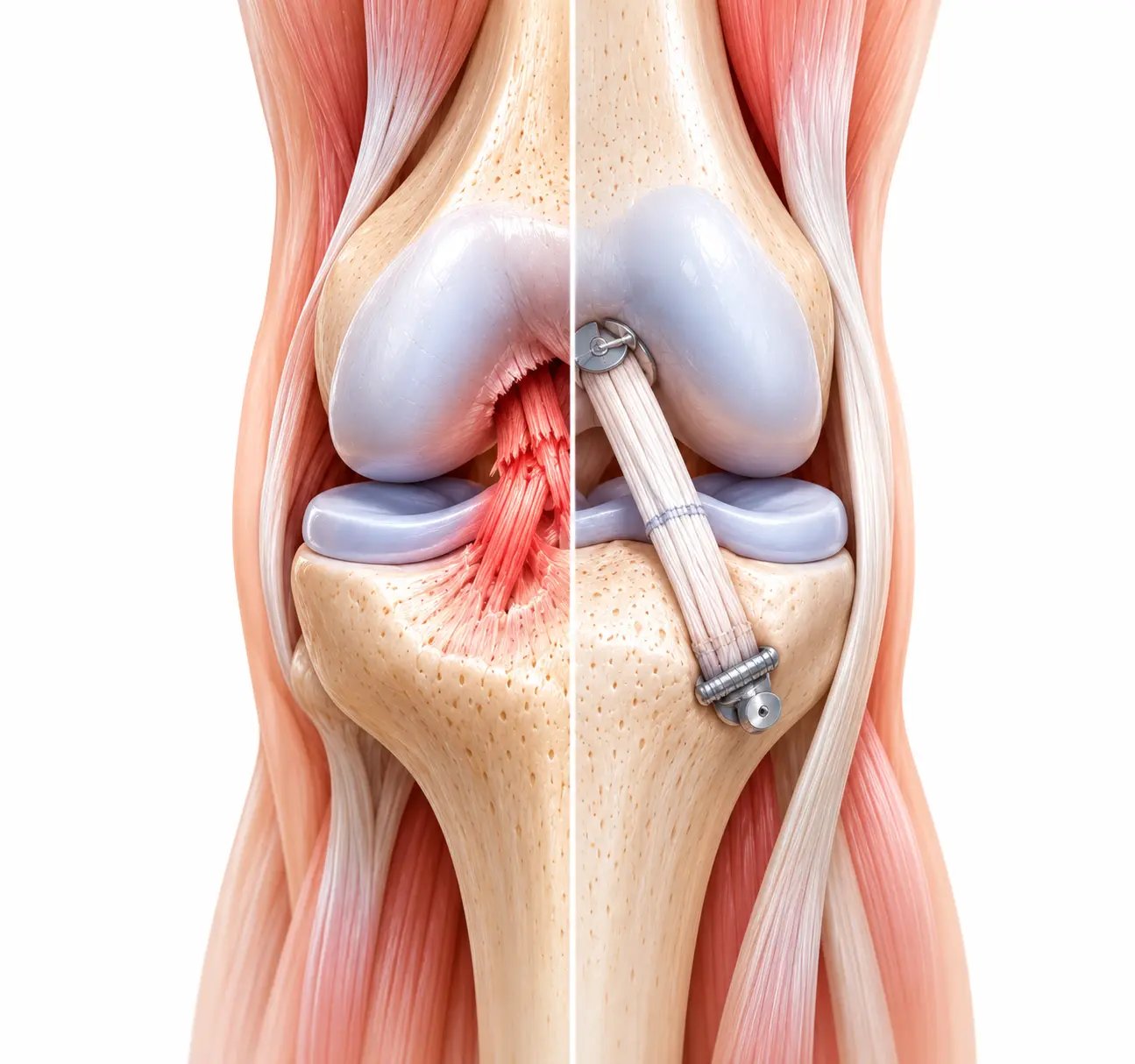
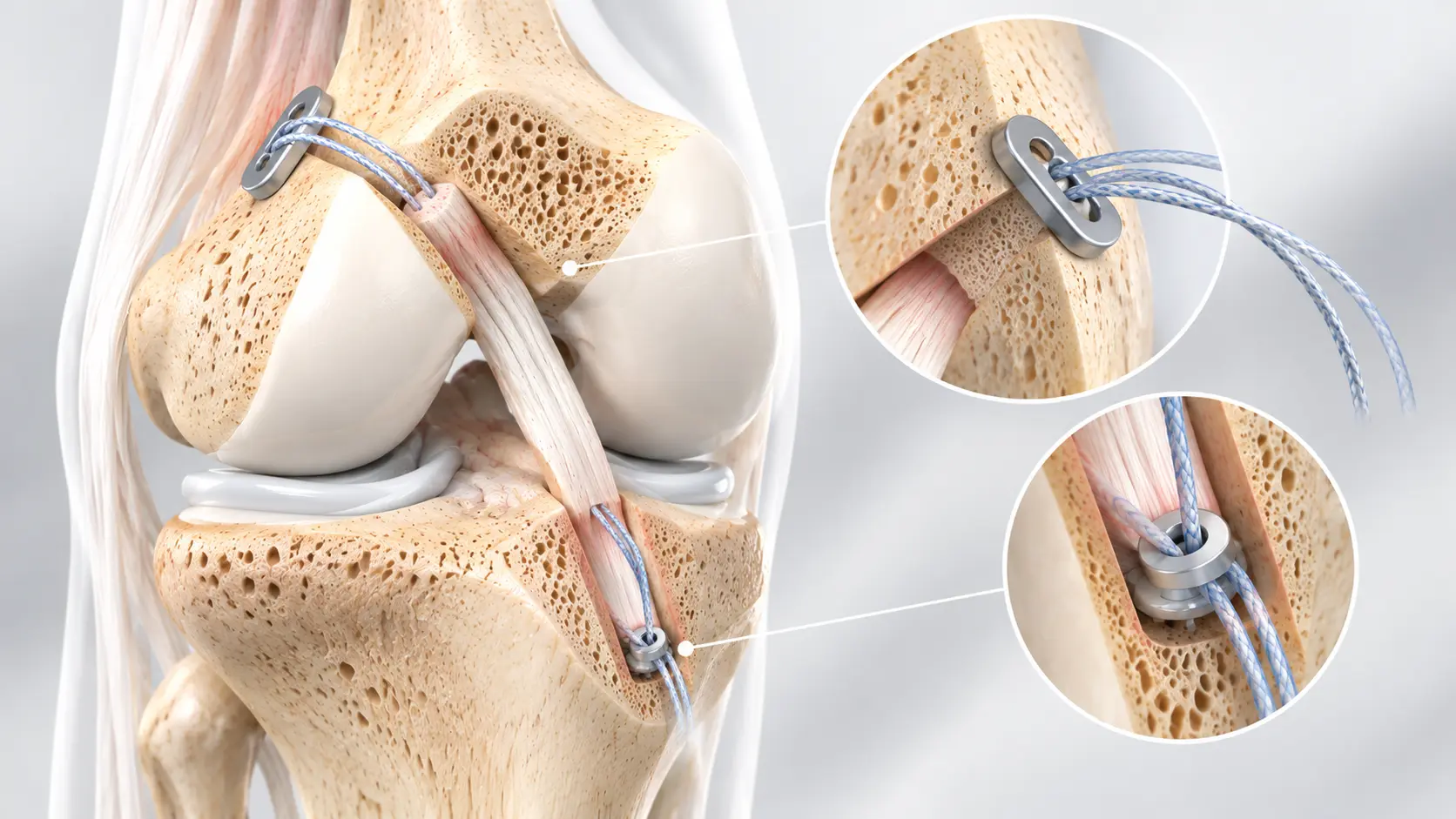
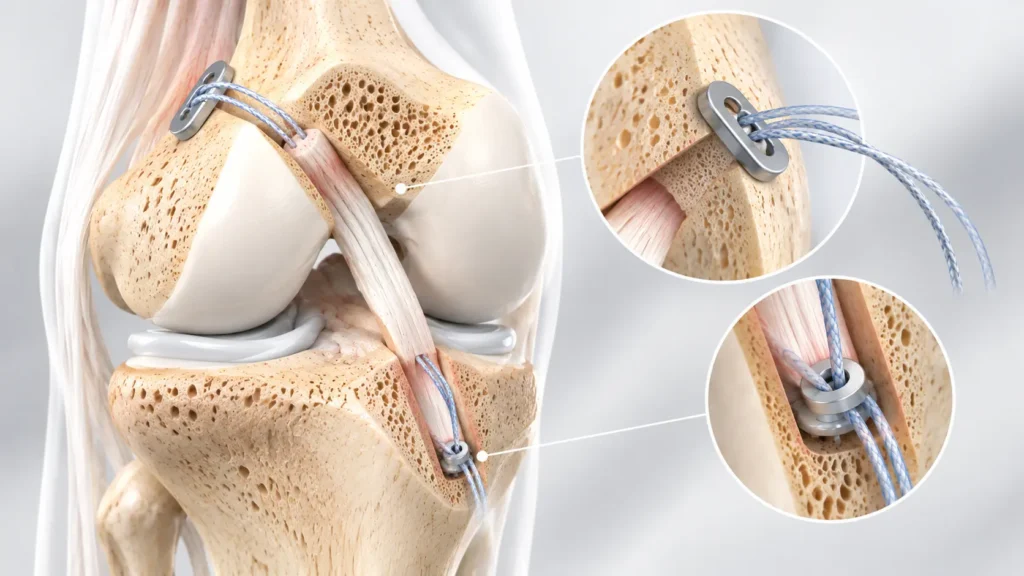
A small metal button that rests on the outer surface of your thigh bone and holds the graft by a loop of very strong suture. Its length can be shortened after the graft is in place, which lets the surgeon tension it precisely.
What is an adjustable loop button?
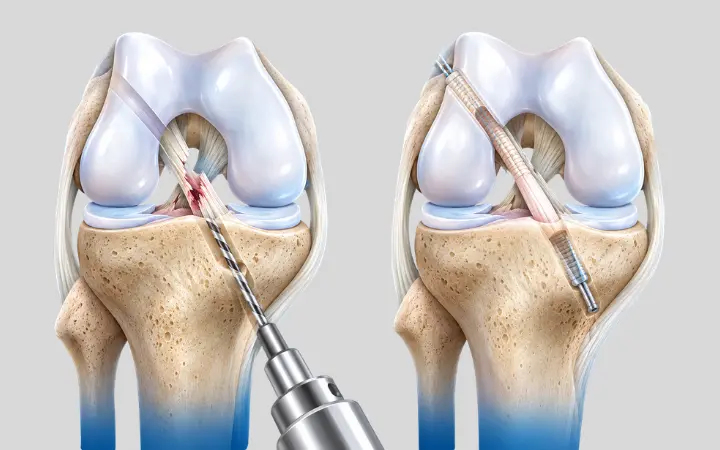
Your new ligament has to be anchored at both ends. One way to do that is to hang it from a tiny metal bar that rests flat against the hard outer surface of the bone, with a loop of very strong suture running down the tunnel to the graft.
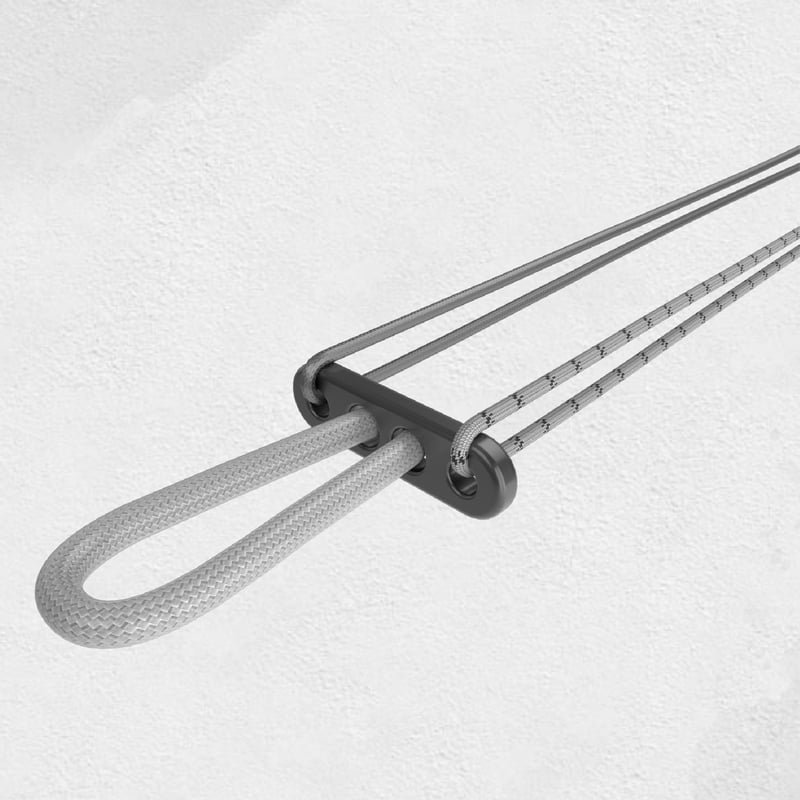
The word adjustable is the important part. In an older fixed loop button the loop is a set length, chosen before the graft goes in. In this design the loop can be shortened after the graft is already inside, by pulling two suture tails. The surgeon pulls the graft the rest of the way into the socket and sets the tension while watching it.
That single feature is what makes short sockets possible, and short sockets are what techniques like all-inside reconstruction are built on. It also lets the surgeon correct the tension if the graft has settled slightly, rather than living with whatever length was estimated beforehand.
When this implant is used
Commonly used for
- Soft tissue grafts such as hamstring, peroneus longus or quadriceps
- All-inside reconstruction, where short sockets are drilled
- Cases where the exact tunnel length is hard to predict
- Revision surgery, where bone quality around old tunnels is poorer
- Growing knees, since nothing is wedged across a growth plate
Less suitable for
- Grafts with bone blocks, which are usually held by screws instead
- Very short femoral tunnels where the button cannot clear the far cortex
- Situations where the outer bone surface is damaged or too thin
- Centres where the surgeon prefers a fixed loop for predictability
- Cases where implant cost is the deciding constraint
How the button is placed
-
01
The socket and a narrow channel
A socket is drilled for the graft, and a much narrower channel continues from it out through the far side of the bone. The button travels through that narrow channel.
-
02
The graft is pulled up
Leading sutures carry the button out through the skin side of the thigh bone, with the graft following up the tunnel behind it.
-
03
The button flips flat
Once clear of the bone, a second suture is pulled to turn the button sideways so it lies flat against the hard outer surface. The surgeon confirms this by feel, by camera, or with an X-ray image.
-
04
The loop is shortened
The two shortening tails are pulled alternately, drawing the graft further into the socket until the planned length of graft sits inside bone.
-
05
The knee is cycled and retensioned
The knee is bent and straightened several times to settle the construct, then the loop is tightened again. Skipping this step is the usual reason a graft feels loose later.
-
06
Final check and closure
Stability is tested, the graft is inspected through the camera, and the suture tails are cut. The button stays where it is permanently.
Two steps decide how well this implant performs. Confirming the button has actually flipped onto bone rather than sitting in soft tissue, and retensioning after cycling the knee. Both are technique, not product.
How it compares with a fixed loop
Both designs do the same job in different ways. A fixed loop is a closed, unchangeable length. An adjustable loop can be shortened once the graft is inside.
Fixed loop
Simple and predictable, but the loop length must be chosen in advance and the tunnel must match it.
Adjustable loop
Tension and graft depth are set after the graft is in, which suits short sockets and uncertain tunnel lengths.
What studies show
Across fifteen studies and over two and a half thousand patients, no meaningful difference in looseness, function scores or revision.
The debate around adjustable loops comes from the laboratory rather than the clinic. In bench testing, some adjustable loops show a small amount of lengthening when cycled repeatedly, which raised a concern that the graft could creep loose. In real patients that concern has not translated into worse results, and the recognised practical answer is simply to cycle the knee and retighten before finishing. The honest summary is that both devices are safe, and the quality of the evidence comparing them is low.
Compare all graft and implant typesWhat this implant means for your recovery
Here is the point most patients miss. The button is strongest on day one and matters less every week after that. Its job is to hold the graft still while your own bone grows into it. Once that has happened, your biology is holding the graft and the button is simply along for the ride.
This is why the early months are protected even though the fixation feels solid immediately. The implant was never the weak link. The healing between graft and bone is.
Open the full recovery roadmapBenefits and trade-offs
Benefits
- Tension and graft depth are set after the graft is already inside
- Makes short socket techniques such as all-inside possible
- Very strong hold from day one, on the hardest part of the bone
- Nothing is wedged inside the tunnel beside the graft
- Safe across growth plates, so it suits growing knees
Trade-offs to know
- Costs more than a fixed loop or a simple screw
- Bench testing shows small loop lengthening under repeated load
- Depends on correct flipping and retensioning technique
- The graft is held a short distance away from the joint
- It is a permanent implant, even though it is rarely felt
If you are comparing quotes between hospitals and one is noticeably cheaper, the fixation is often where the difference sits. That does not make the cheaper option wrong. A well placed fixed loop button or a screw can hold a graft perfectly well. What matters is that the choice is made for your graft and your tunnels, not purely on price in either direction.
Cost of this implant
Per button. Most reconstructions use one or two, depending on the technique.
An all-inside reconstruction uses a button at both ends, so two are needed. A standard reconstruction usually uses one on the thigh bone side with a screw below. Ask for the implant list in your estimate, since this is the line that varies most between hospitals. Most health insurance policies cover implants as part of the procedure, and our team can help you with the paperwork.
Common questions
Will the metal stay in my leg forever?
Yes, and that is intended. The button is designed to stay permanently. It is tiny, it sits flat against the bone under the muscle, and the large majority of patients never feel it.
Can I have an MRI scan later?
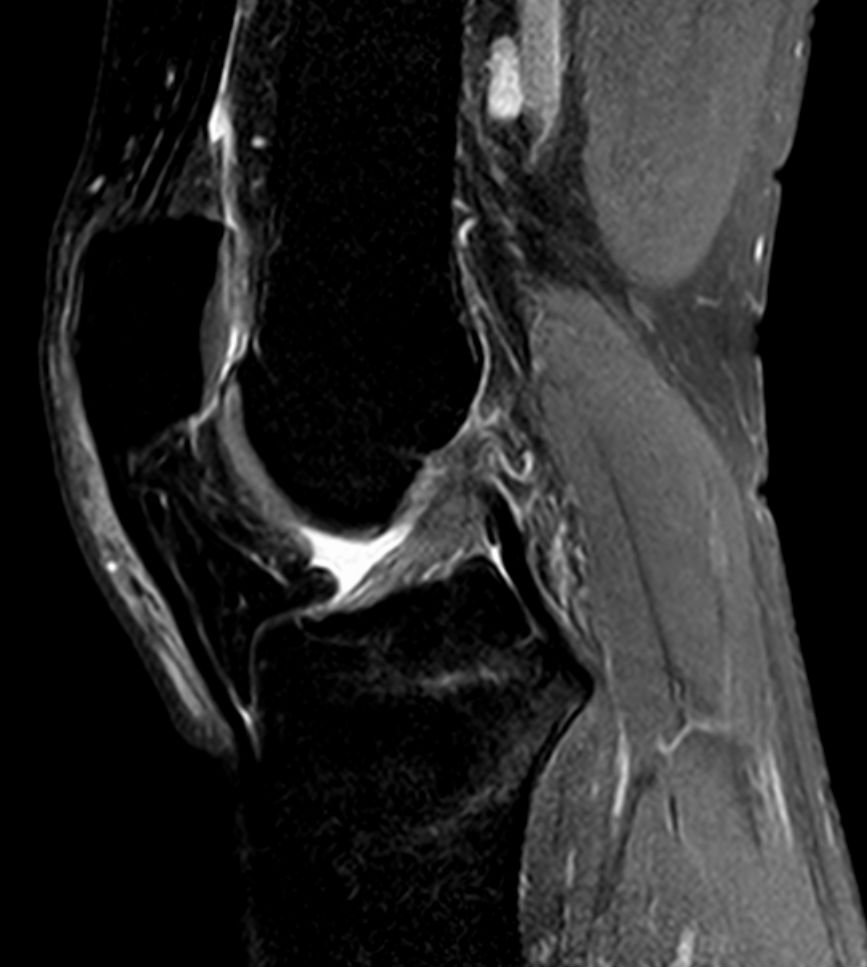
Yes. These buttons are made of titanium and are safe in an MRI scanner. They can cause a small smudge on the image near the implant, which radiologists are used to working around.
Will it set off airport security?
Almost never. The implant is very small. If a scanner is ever triggered, telling the staff you have had knee surgery is enough, and no certificate is required.
Can the loop loosen and make my knee loose again?
Laboratory testing shows a small amount of lengthening when these loops are cycled hard, which is why surgeons bend the knee several times and then retighten before finishing. In patient studies, results have matched fixed loop devices.
Will I feel it when I lie on my side or press there?
Rarely. It sits on the outer side of the thigh bone under muscle, not just under skin. Occasional tenderness over the area settles as the soft tissue heals.
Is it better than a screw?
Not better, different. A button hangs the graft from outside the bone, a screw wedges it inside the tunnel. Soft tissue grafts suit buttons, grafts with bone blocks suit screws, and many reconstructions use one of each.
This page explains an implant in general terms. Which fixation suits your knee depends on your graft, tunnels, and bone quality, planned with a leading ACL surgeon in Indore and confirmed during surgery.

Dr. Prince Uchadiya

Thank You,
Patient!
Your appointment request has been received.
Our clinic team will call you shortly to confirm your consultation and share further details.
 Confirm on WhatsApp
