


Synthetic Graft
An artificial ligament made from woven polyester fibres, used in place of your own tendon. It is not a routine choice anywhere in the world, and understanding why matters more than understanding how it works.
Animation or OT footage showing how a synthetic ligament is passed and fixed.
What is a synthetic graft?
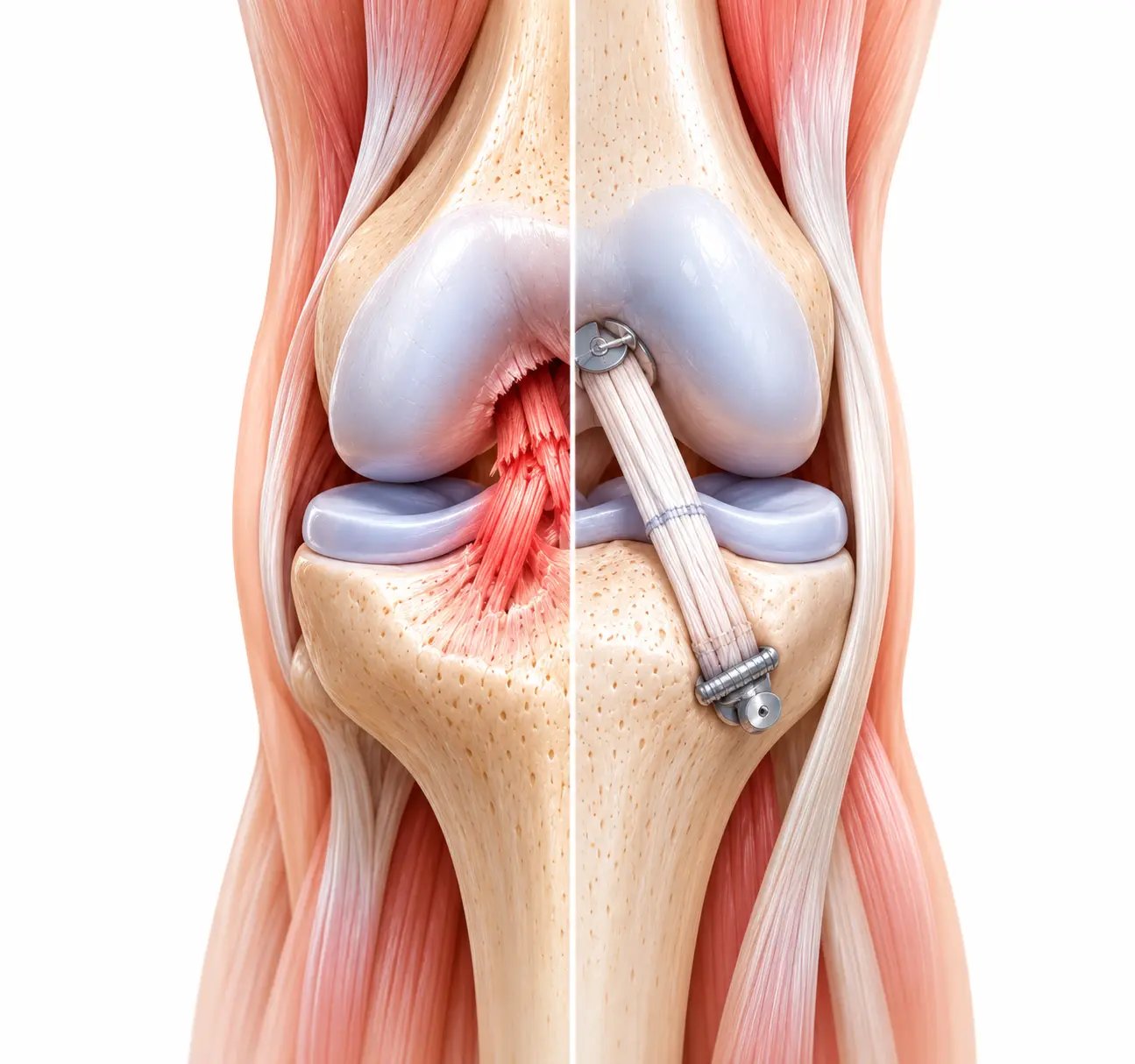
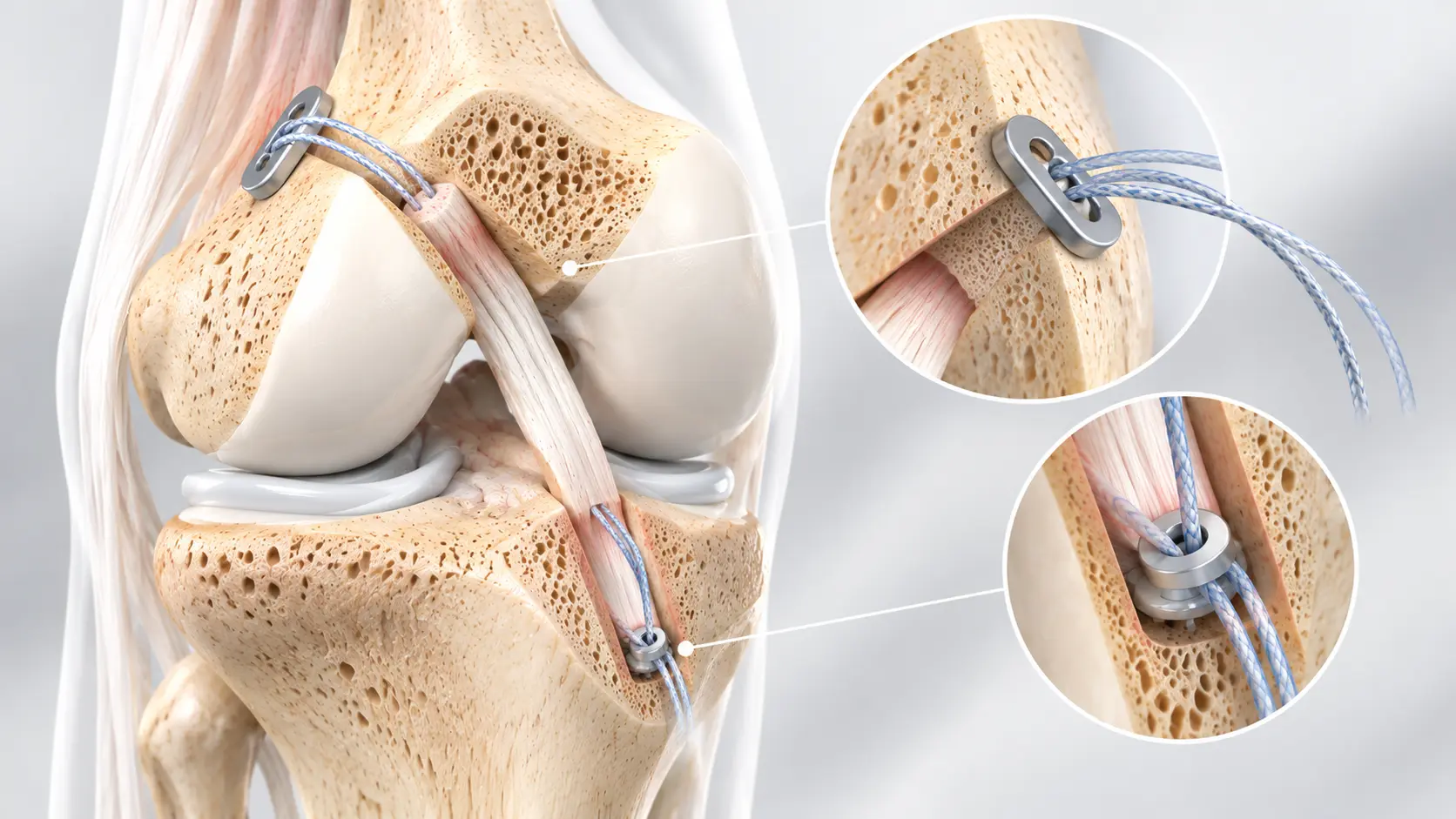
It is a ligament made in a factory rather than taken from your body. Fine polyester fibres are woven into a cord, with a twisted section meant to sit inside the joint and straighter woven ends that go into the bone tunnels.
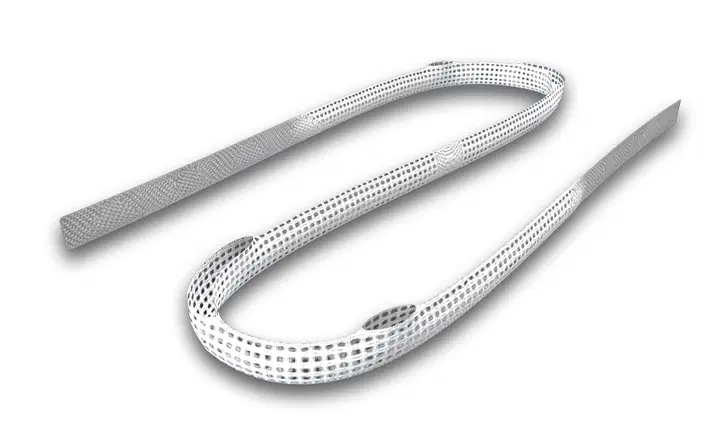
That last point is the heart of the matter. When your own tendon is used, your body gradually colonises it with blood vessels and cells and turns it into living ligament tissue. A synthetic cord cannot do that. It stays a piece of material, carrying load indefinitely without ever being replaced by biology.
The idea has a difficult history. Several synthetic ligaments were introduced from the 1970s onwards and most were withdrawn after poor results. In the systematic review evidence, older devices showed failure rates of roughly a third for one material and around one in eight for others. Fragments worn off the implant irritated the joint lining, and tunnels widened around the material. Those failures are why the whole category is viewed with caution.
Who this graft suits
This is the shortest list of any graft on this site, and that is the honest position rather than a reluctance to offer it.
Occasionally considered for
- Multiple revision surgery where own tendon options are exhausted
- Patients who cannot have tendon taken for a specific medical reason
- Selected multiligament injuries needing several reconstructions at once
- Cases where donor tissue is unavailable or unsuitable
- Always after a full discussion of the limited long term evidence
Not advised for
- A first time ACL tear, where your own tendon is the better option
- Young patients with decades of knee use ahead
- Competitive pivoting athletes
- Anyone choosing it mainly to recover faster
- Growing children and teenagers
How it is used in surgery
-
01
Anaesthesia and examination
The surgery is done under spinal or general anaesthesia, with the knee examined again once you are relaxed.
-
02
Camera inside the knee
The joint is inspected and any meniscus or cartilage problem is treated. No tendon is harvested, so there is no separate donor site cut.
-
03
Tunnels are prepared
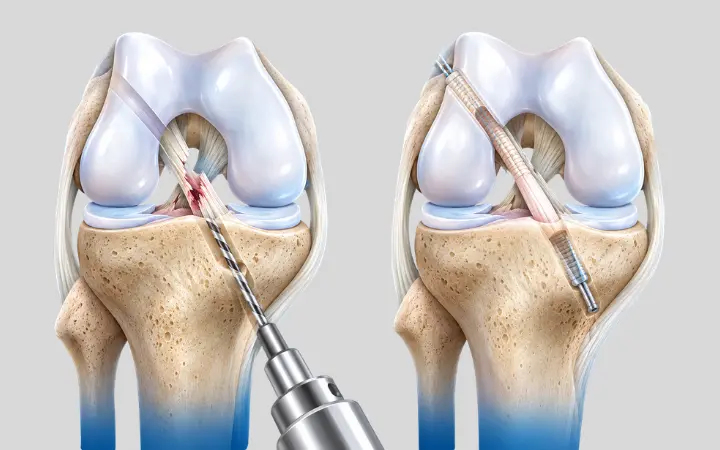
Tunnels are drilled in the thigh bone and shin bone at the original attachment points, as in any reconstruction.
-
04
The implant is positioned
The ligament is passed so that the twisted, free part sits inside the joint and the woven parts sit inside bone. Getting this junction in the right place matters, because material in the wrong zone wears faster.
-
05
Fixation at both ends
Screws or other fixation hold each end in the tunnel. There is no healing in period to wait for, so the construct is as strong as it will ever be at this point.
-
06
Movement checked and closure
The knee is taken through its full range to confirm nothing catches or rubs, since a synthetic that impinges will wear against bone.
Tunnel position is less forgiving with a synthetic than with a tendon graft. A tendon can remodel and adapt slightly over months. A woven cord cannot, so any rubbing continues for as long as the implant is in the knee.
What the evidence actually says
It is worth separating the older devices from the current one, because they are not the same story.
Older devices
Largely abandoned. Failure rates in review data ran from roughly one in eight up to about a third.
Current device
A review of 843 knees reported failure and revision of about 2.6 percent each, which is far better.
The catch
None of those studies followed patients beyond five years, and most were not comparative.
Reviewers have been consistent on what this means. The available studies carried a high risk of bias, could not be pooled properly, and did not compare synthetics directly against your own tendon under equal conditions. One review concluded plainly that the evidence could neither support nor rule out its use and that clinicians should proceed with caution.
Set that against what we know about tendon grafts, where registry data covers tens of thousands of patients and follow up runs for decades. An ACL graft has to last you forty or fifty years. Five years of favourable data does not answer that question, and for a young knee the question is the only one that matters.
Compare all graft and implant typesRecovery at a glance
No tendon is taken, so the early weeks are usually comfortable and there is no donor site to recover from. That is the honest attraction of this option.
The faster return to sport that is sometimes claimed for synthetics does not follow from the research, and it carries its own risk. The implant may be strong from day one, but the bone around the tunnels still needs months to settle, and your muscle control and balance still need the same retraining. Our advice does not change here, return to pivoting sport is decided by testing, not by the material in your knee.
Open the full recovery roadmapBenefits and trade-offs
Benefits
- Nothing is taken from your body, so there is no donor site
- No hamstring weakness and no front of knee pain
- Very high strength immediately after fixation
- Available when a patient has run out of their own tendon options
- Shorter surgery, since no graft has to be harvested and prepared
Trade-offs to know
- It never becomes living tissue, so it cannot repair itself
- Worn fibres can irritate the joint lining over the years
- Tunnels can widen around the material, complicating revision
- Little published follow up beyond five years
- Materially more expensive than using your own tendon
Our position, stated plainly. For a standard ACL tear we recommend your own tendon, because the evidence behind it is deeper, longer and stronger, and because a graft that becomes living tissue can look after itself in a way that woven polyester never will. A synthetic has a place when a patient has genuinely run out of other options, and that conversation should be had carefully rather than quickly.
Cost of this graft
The implant itself is purchased, unlike your own tendon, which has no material cost.
This is the most expensive graft option, because the ligament is a manufactured device rather than your own tissue. Some insurance policies query synthetic implants, so clarify cover before surgery is scheduled. Our team can help you with the paperwork.
Common questions
Can I get back to sport faster with a synthetic?
This claim is often made and the research does not support it. The implant is strong immediately, but the bone around your tunnels still needs months, and your strength and balance need the same retraining as anyone else. Returning early is how knees get injured again.
Why not use it if nothing is taken from my body?
Because of what happens later rather than what happens in the first months. Your own tendon turns into living tissue that can maintain itself. A synthetic cord carries load for as long as it stays in your knee, and worn fibres can irritate the joint over the years.
I read the newer ones are much better. Is that true?
Partly. The current device has much lower reported failure than the older ones that were withdrawn. The limitation is that published follow up does not extend beyond about five years, and most studies were not direct comparisons with tendon grafts.
What happens if a synthetic ligament fails?
Revision is possible but more complex. The tunnels may have widened around the material, which can require bone grafting first and a second operation months later.
Will it set off airport security or affect an MRI?
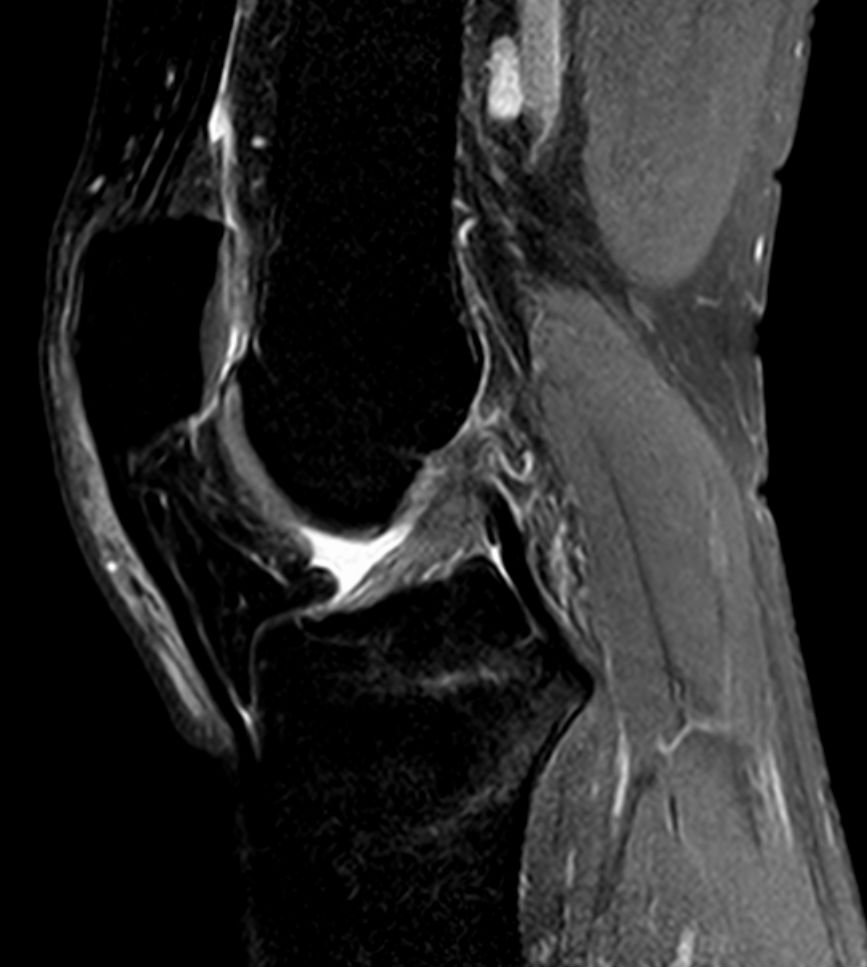
The ligament itself is a woven fibre, not metal, so it does not trigger scanners. The screws fixing it may be metal, and those are still safe in an MRI.
So when would you actually use one?
Mainly when a patient has had several previous surgeries and their own tendon options are used up, or when tendon cannot be taken for a specific medical reason. It is a solution to a shortage, not an upgrade.
This page explains a graft option in general terms. Which graft suits your knee is decided after an examination, MRI, and long-term evidence review with Dr. Prince Uchadiya, ACL surgeon in Indore.

Dr. Prince Uchadiya

Thank You,
Patient!
Your appointment request has been received.
Our clinic team will call you shortly to confirm your consultation and share further details.
 Confirm on WhatsApp
