
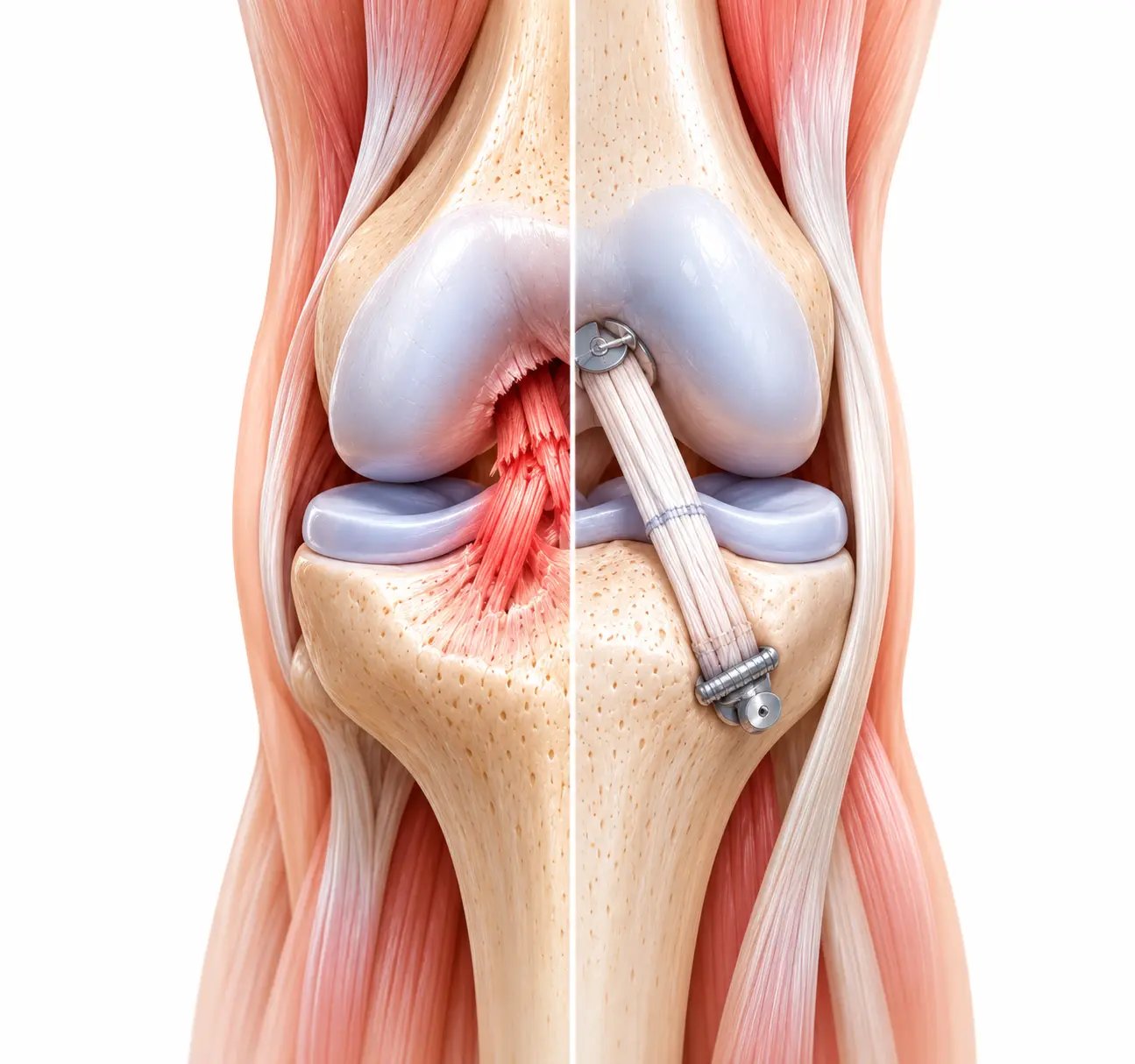
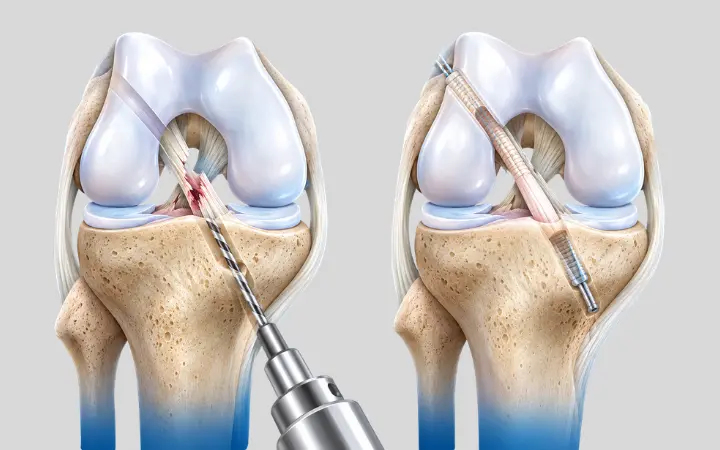



Meniscus Repair Implants
Tiny anchors joined by a strong suture, used to pull the two sides of a torn meniscus together and hold them while they heal. The number you need depends on how long your tear is.
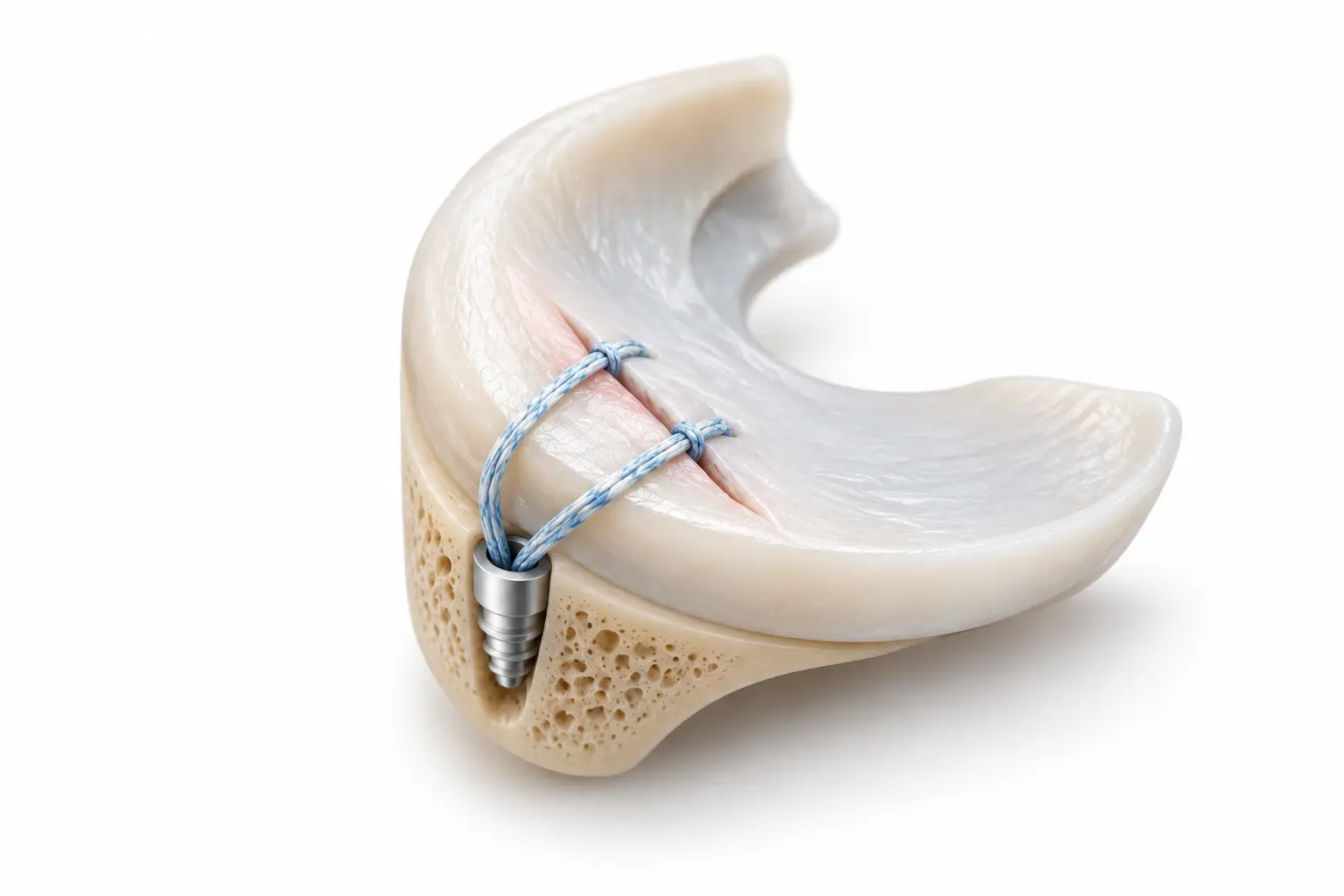
What is a meniscus repair implant?
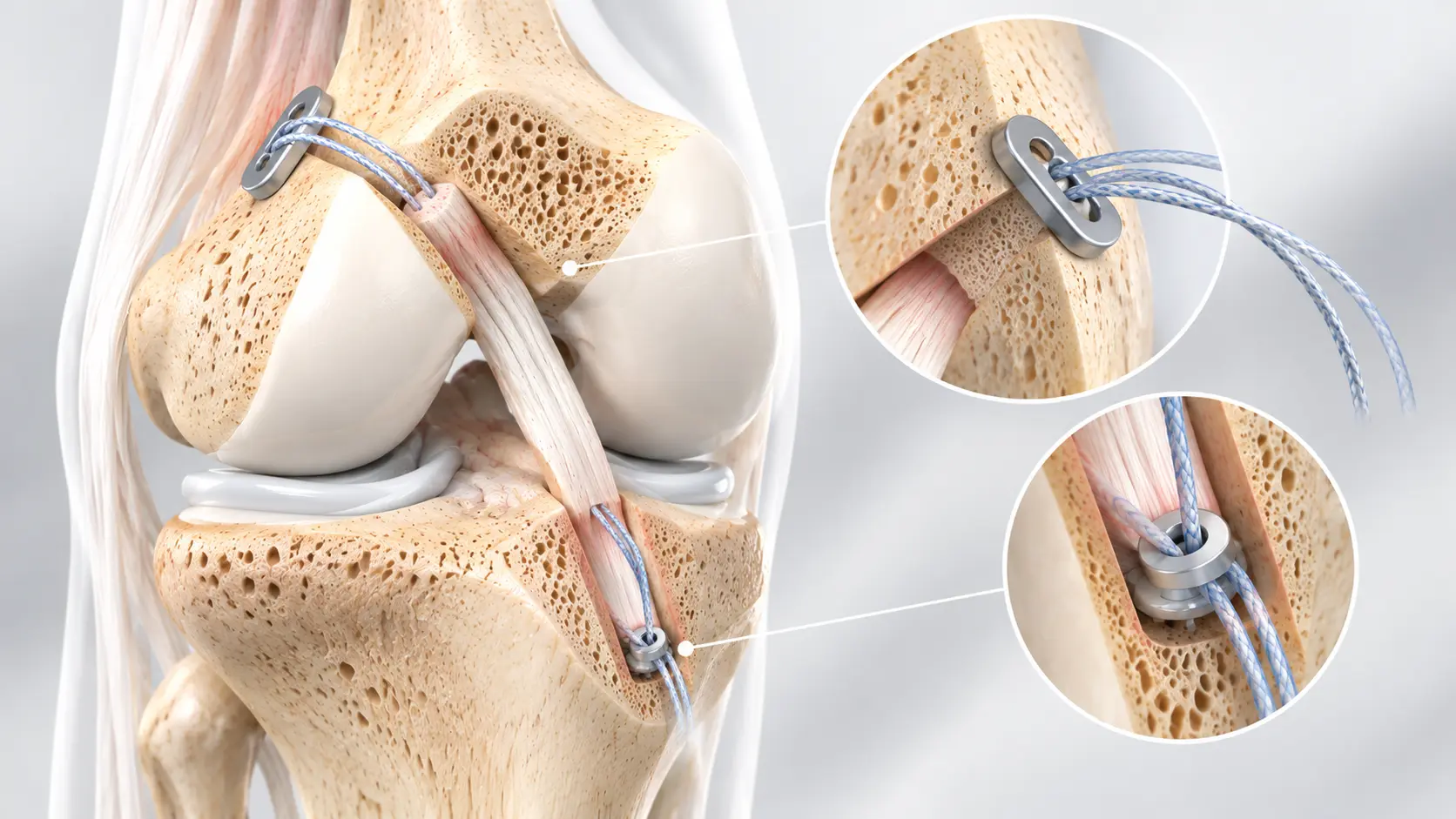
The modern version is a small device with two tiny anchors joined by a single strong suture, with a knot that can only slide one way. Each anchor is pushed through the torn meniscus and parked against the tough capsule just behind it.
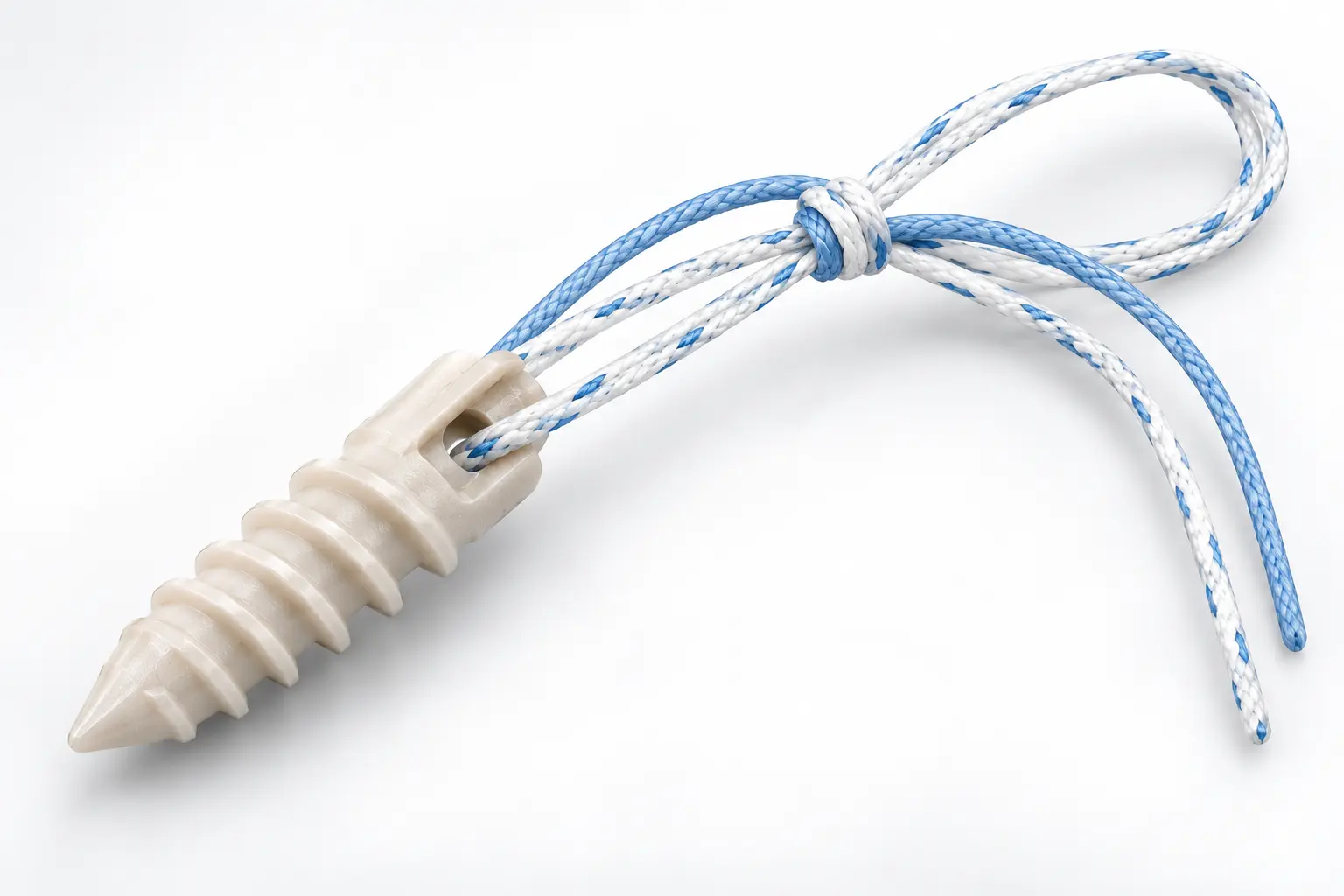
This matters because the meniscus is at the back of a very tight space. Tying knots back there by hand is difficult, and older methods required extra cuts and needles passed out through the skin. These devices let the whole repair be done through the same keyholes used for the rest of the surgery.
One point to understand early, because it shapes your bill. These are priced individually and a tear is closed with several of them, usually one every few millimetres. A short tear may need two. A long one may need five or six.
When these implants are used
Commonly used for
- Tears at the outer rim, where blood supply allows healing
- Tears at the back corner, often found alongside an ACL tear
- Bucket handle tears that have flipped out of position
- Repairs done at the same time as an ACL reconstruction
- Younger patients, whose tissue heals more readily
Not used for
- Tears in the inner part, which has almost no blood supply
- Shredded tears that cannot be brought back together
- Old degenerate tears in a worn meniscus
- Small stable tears that will heal on their own
- Patients unable to follow the protected early rehabilitation
How the implant is placed
-
01
The tear is prepared
The torn edges are freshened with a rasp or shaver so raw surfaces face each other. Healing comes from this step as much as from the implant.
-
02
Depth is set on the device
A stop on the instrument is adjusted so the needle goes just far enough to clear the capsule. This is what keeps the anchor from travelling further back than it should.
-
03
First anchor is deployed
The needle is passed through the meniscus on one side of the tear and the anchor is released behind it, where it turns and catches against the capsule.
-
04
Second anchor is deployed
The needle is withdrawn and passed again on the other side of the tear, and the second anchor is released. The suture now bridges the tear.
-
05
The stitch is tightened
The free end is pulled, sliding the knot down and squeezing the tear closed. The surgeon probes it to confirm the edges sit together with no gap.
-
06
Repeat along the tear
More implants are placed along the length of the tear until the whole of it is closed, then the suture ends are trimmed short inside the joint.
The depth setting in step two is the safety step. Important nerves and blood vessels lie behind the knee, and limiting how far the needle can travel is what keeps them out of the way.
Three ways a meniscus is repaired
Your operation note may mention any of these. Often more than one is used in the same knee, matched to where the tear sits.
All inside
The anchor devices described here. Done entirely through the keyholes, with no extra cuts.
Inside out
Long needles carry sutures out through a small extra cut, where they are tied against the capsule.
Root repair
The detached end is pulled down a small tunnel in the shin bone and tied over a button on the surface.
A fair word on the comparison between the first two. Pooled data from twenty four studies covering more than two thousand repaired menisci found similar patient scores and similar complication rates, but a somewhat higher failure rate with all inside devices than with inside out stitches. The difference was influenced heavily by one study of elite athletes, and the evidence sits at a moderate level rather than a strong one. In practice many surgeons still reach for inside out stitches for large or complex tears, and use all inside devices for the rest.
Compare all graft and implant typesWhat these implants mean for your recovery
This is the one implant on the site that genuinely changes what you are allowed to do. The anchors hold the tear closed, but deep bending pushes the back of the meniscus apart and can pull the repair open before it has knitted. That is why your brace and your bending limits exist in the early weeks.
Squatting on the floor and sitting cross legged are usually the last things permitted, often around three to four months. Waiting that out is the main thing you can personally do to make the repair succeed.
Open the full recovery roadmapBenefits and trade-offs
Benefits
- Lets the meniscus be saved instead of trimmed away
- No extra cuts, since everything goes through the keyholes
- Reaches the back corner, which is hard to stitch by hand
- Compression can be judged and adjusted as the knot slides
- Patient scores comparable to traditional stitching methods
Trade-offs to know
- Priced individually, so a long tear costs more than a short one
- Somewhat higher failure rate than inside out stitching in pooled data
- The anchors stay behind the meniscus permanently
- A more protected and slower first six weeks
- Not every repair heals, whatever implant is used
Keep the comparison in proportion. The meaningful choice is not between one implant and another, it is between repairing the meniscus and removing the torn piece. Removal gives you a quicker, easier few months and a knee with less cushion for the next thirty years. Every implant on this page exists so that trade does not have to be made.
Cost of these implants
Per implant. A typical repair uses two to five, depending on the length of the tear.
This is the line in an ACL estimate that most often moves after surgery, because the exact number of implants is only known once the tear is seen and probed. We give you a range beforehand rather than a single figure, and we explain afterwards how many were used and why. Most health insurance policies cover implants as part of the procedure, and our team can help you with the paperwork.
Common questions
Why did my bill go up after surgery?
Almost always because the tear needed more implants than the estimate assumed. The count can only be decided once the tear is seen and probed from inside. Ask for the implant count and the reason, and both should be explained to you clearly.
Can fewer implants be used to save money?
Not safely. Spacing them too far apart leaves gaps in the tear where the edges are not held together, and a gap is where a repair fails. The count follows the length of the tear.
Do the anchors stay inside me?
Yes. They sit behind the meniscus against the capsule, are very small, and are not felt. They are not removed unless there is a specific problem, which is uncommon.
Can I have an MRI afterwards?
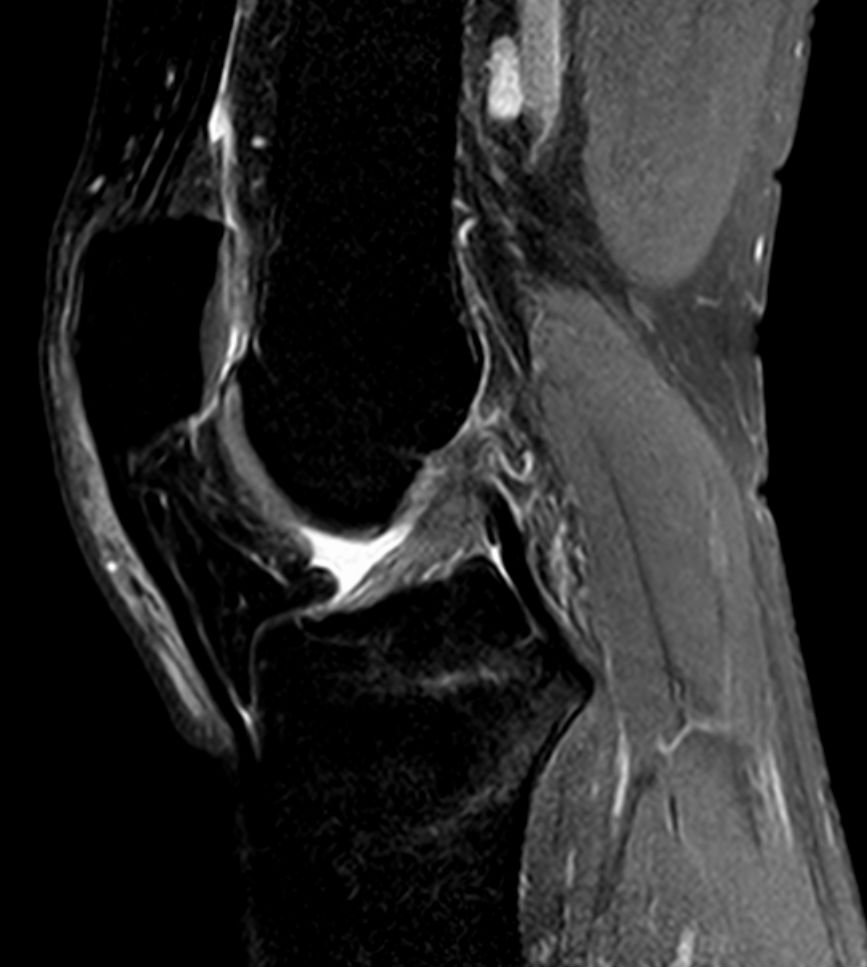
Yes. These implants are polymer and suture rather than metal, and are safe in an MRI scanner.
Why do I need a brace when my ACL alone would not need one?
The brace is protecting the meniscus stitches, not the ACL graft. Deep bending pulls the back of the meniscus apart, so bending is limited while the tear knits.
What happens if the repair does not heal?
Not every repair heals, and a repair that fails can usually be dealt with later by a small keyhole procedure. Even then, attempting the repair was worth it, because a meniscus that heals protects the joint for decades.
This page explains an implant in general terms. Whether your tear can be repaired, along with how many anchors it requires, is evaluated on MRI and confirmed arthroscopically by a specialist ACL and meniscus surgeon in Indore.

Dr. Prince Uchadiya

Thank You,
Patient!
Your appointment request has been received.
Our clinic team will call you shortly to confirm your consultation and share further details.
 Confirm on WhatsApp
